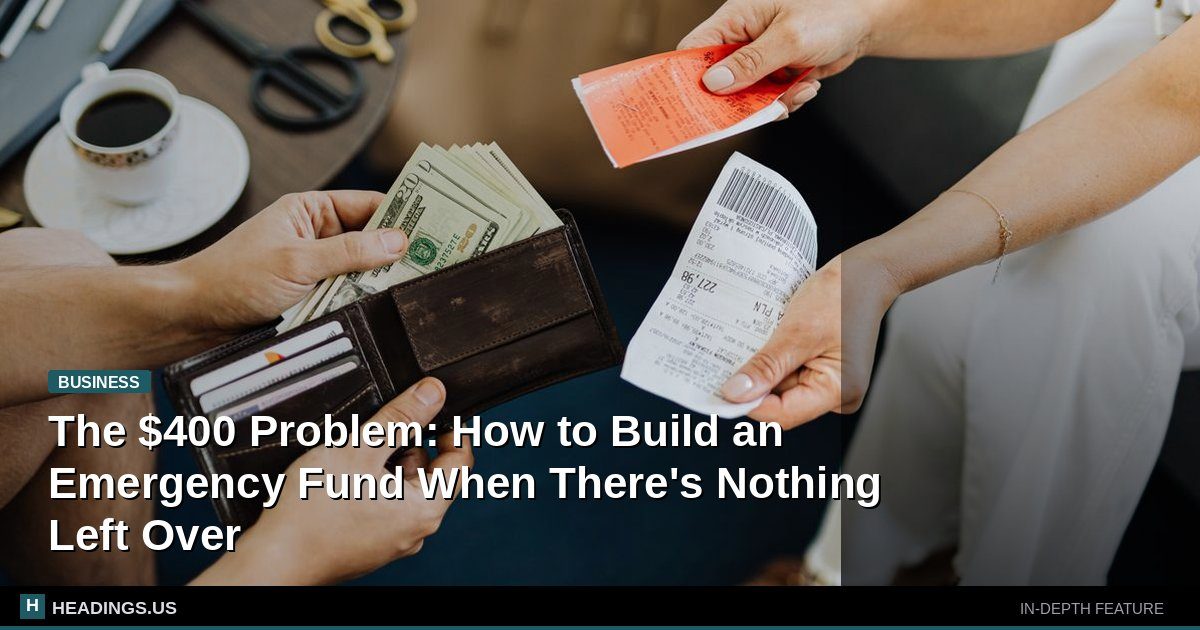
Latoya Jenkins knew the math was bad. She just didn't know how bad until her car's alternator died on a Tuesday morning in 2023. The repair estimate was $612. She had $83 in her checking account and payday was nine days away.
"I sat in the parking lot of the shop and cried," said Jenkins, 34, a medical billing specialist in Charlotte, North Carolina. "I make decent money. I just never have any of it."
Jenkins is not an outlier. She's the norm.
The Federal Reserve's Economic Well-Being of U.S. Households report found that 37 percent of American adults could not cover a $400 emergency expense using cash or its equivalent. Among households earning under $50,000, that figure climbs above half. And the problem isn't just about income. A 2023 survey from the payroll firm ADP found that 61 percent of workers earning between $50,000 and $100,000 also reported living paycheck to paycheck.
So the standard advice — "just save three to six months of expenses" — lands like a punchline. Three months of expenses for the median American household is roughly $15,000. Telling someone with $83 in checking to save $15,000 is like telling them to fly to the moon. The gap between the advice and the reality is where most people give up.
The people who actually get out of this hole don't do it by following the standard advice. They do it by ignoring it, at least at first.
Start With $500, Not Six Months
The conventional wisdom of a three-to-six-month emergency fund is designed for people who already have their financial house in order. For everyone else, it's a demotivating fantasy. Financial planners who work with low-income clients have largely abandoned it as a starting point.
"The first goal is not three months. The first goal is one car repair," said Saundra Davis, a financial coach and founder of Sage Financial Solutions in the Bay Area, who has spent two decades working with people in financial crisis. "You need a number that feels possible. Five hundred dollars is possible. Fifteen thousand dollars is not."
Why $500? Because it covers the most common financial emergencies. According to the Federal Reserve's data, the median unexpected expense that people report is around $400. A tire blowout, a urgent care visit, a broken phone, a same-day plumber. Five hundred dollars doesn't solve everything, but it turns a crisis into an inconvenience.
Jenkins started with $20 a week. Not $20 a day. Not 20 percent of her income. Twenty dollars, transferred automatically every Friday into a separate savings account at a different bank than her checking account. It took her about six months to hit $500. Then she kept going.
Automate It So You Never See It
The single most effective tactic, according to behavioral economists and financial coaches alike, is removing the decision from the equation. If you have to decide each week whether to save, you will eventually decide not to.
A 2022 study published in the Journal of Consumer Research found that automatic transfers dramatically increase savings rates among low-income households, in part because they reduce the mental friction of saying no to yourself. The money moves before you have a chance to spend it.
Set up a recurring transfer for the day after you get paid. Even $10. Even $5. The amount matters less than the habit. Once the transfer becomes invisible, you adjust your spending to the smaller number without really noticing.
"The amount is almost irrelevant at the beginning. What matters is that you stop being someone who doesn't save and start being someone who does." — Saundra Davis, financial coach
There's a second benefit to automation: it separates your emergency fund from your checking account. If the money is sitting in the same account you use for groceries and gas, it's not really saved. It's just waiting to be spent. Open a savings account at a different institution — ideally one without a debit card attached.
Find the Money You're Already Losing
Most people living paycheck to paycheck believe they have no money to save. That's usually not quite true. They have money they're losing without realizing it.
Start with fees. The Consumer Financial Protection Bureau has estimated that Americans pay roughly $12 billion a year in overdraft and insufficient funds fees alone. If you're paying $35 every time you swipe when your balance is low, that's not a budget problem. That's a bank problem. Call your bank and ask them to remove overdraft protection entirely, or switch to an account that doesn't charge the fees. Many credit unions and online banks now offer accounts with no overdraft fees at all.
Next, look at subscriptions. A 2024 survey from the research firm C+R Research found that consumers underestimate their monthly subscription spending by more than $130 — they guessed $86 a month, but the actual average was $219. That's more than $1,500 a year in charges many people can't even name.
Then there's the debt itself. If you're carrying credit card balances at 22 percent or higher, every dollar you save while paying that interest is a losing trade. The math is brutal but simple: paying off a credit card with a 24 percent interest rate is equivalent to earning a guaranteed 24 percent return on your money. No savings account on earth pays that.
This creates a genuine tension. Should you save or pay down debt first? The answer most financial coaches give: do both, but tilt toward the minimum. Save $500 first, then redirect extra money toward the highest-interest debt, then come back and build the fund further.
Use the Windfalls You're Already Getting
Tax refunds. Stimulus payments. Bonuses. Birthday money. The $200 your aunt sends at Christmas. These are the moments when an emergency fund gets built fastest, because the money arrives before it's been claimed by bills.
The average federal tax refund in 2024 was about $3,000, according to IRS data. For a household living paycheck to paycheck, that refund is often the single largest lump sum of the year. Most of it disappears within weeks. Some of it doesn't have to.
The rule that works: split the windfall before you spend any of it. Put 20 percent into the emergency fund the day it lands. Spend or pay down debt with the rest. You won't miss the 20 percent because you never had a chance to plan around it.
What to Do When You Have to Use It
Here's the part nobody tells you: you will eventually use the money. That's the point. An emergency fund you never touch isn't a fund. It's a museum exhibit.
When Jenkins finally hit $1,200, her furnace died in January. The repair cost $840. She paid it from savings and had $360 left. She didn't panic. She didn't put it on a credit card. She just started refilling.
"That was the first time in my adult life I didn't have to borrow from somebody," she said. "It felt like being a real grown-up."
The goal isn't to never have an emergency. The goal is to have one without it turning into a crisis. That starts with $5, a separate account, and a decision to stop waiting for the perfect moment to begin.
There is no perfect moment. There's just the next paycheck, and what you do with it.