The numbers tell two stories at once, and they run in opposite directions.
By the federal government's own count, the share of American wage and salary workers belonging to a union fell to 10.1 percent, the lowest rate on record since the Bureau of Labor Statistics began tracking the figure in 1983. That is roughly 14.4 million workers. In 1983, the rate was 20.1 percent. Go back to the mid-1950s, and about one in three American workers carried a union card.
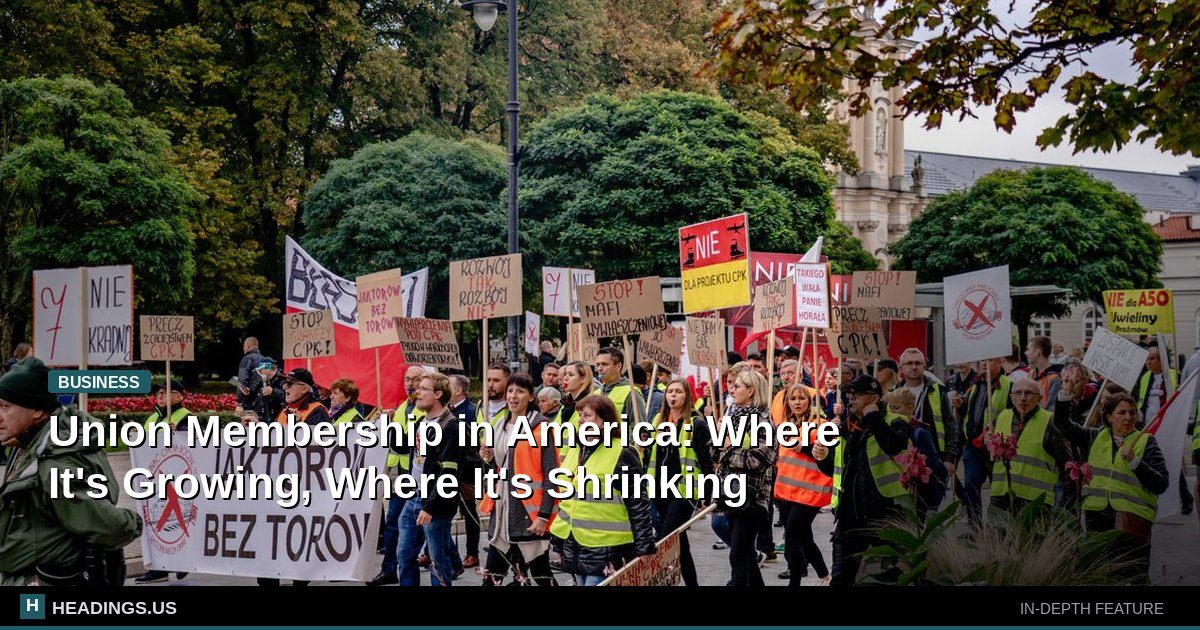
And yet the same era produced the most visible wave of new organizing in a generation: Starbucks baristas, Amazon warehouse workers, hospital residents, graduate students, and video game testers. The National Labor Relations Board reported a sharp jump in union election petitions, the highest in years. Approval of unions in Gallup polling hit 71 percent, near its highest reading since the 1960s.
So how can membership be shrinking while organizing is surging? The answer is geography, industry, and arithmetic. Unions are growing in a handful of sectors and states, and shrinking almost everywhere else. Understanding which is which matters whether you are a worker weighing a union vote, an employer preparing for one, or a taxpayer watching the fight play out.
The South Is Still the Hardest Ground
Look at a map and the divide is stark. Hawaii, New York, and Washington have unionization rates above 16 percent. South Carolina, North Carolina, and Utah sit below 5 percent. The single biggest reason is law: 26 states have right-to-work statutes, which let workers covered by a union contract opt out of paying dues or fees. Nearly all of them are in the South and Mountain West.
The practical effect showed up at the Volkswagen plant in Chattanooga, Tennessee, where workers voted to join the United Auto Workers, a rare Southern win. Weeks later, workers at a Mercedes-Benz plant in Vance, Alabama, voted it down. Same industry, same company playbook, different outcome. The UAW poured money and organizers into both.
Southern governors made their position plain. In a joint statement, six governors warned that joining a union would threaten jobs and "the values we hold dear." That kind of pressure is hard to quantify but easy to feel on a shop floor.
Where Membership Is Actually Growing
Three sectors stand out.
- Health care. Nurses and hospital staff have organized at a steady clip, driven by staffing shortages and burnout. Thousands of resident physicians at hospitals including Stanford Health Care and Mass General Brigham voted to unionize, an unusual move for doctors in training.
- Higher education. Graduate student workers at schools such as Boston University and the University of Chicago have won elections, expanding a foothold that barely existed two decades ago.
- Logistics and warehouses. The Teamsters won a contract at UPS covering roughly 340,000 workers, one of the largest private-sector agreements in the country, and have pushed into Amazon facilities.
Public-sector unions remain the backbone. About a third of government workers belong to a union, compared with roughly 6 percent of private-sector workers. That gap is the whole story of American labor in one statistic.
The Starbucks and Amazon Test Cases
No two campaigns illustrate the gap between momentum and membership better than these.
Starbucks Workers United organized hundreds of stores starting in Buffalo, New York. Then the company and the union spent years fighting over bargaining, with the two sides eventually agreeing to restart talks. Winning an election and winning a contract are different things, and the distance between them is where most campaigns stall.
At Amazon, a JFK8 warehouse in Staten Island voted to unionize in 2022, the company's first successful US facility. More than two years later, workers there still did not have a contract. Meanwhile, a separate Amazon Labor Union effort at a nearby facility failed, and the original group later affiliated with the Teamsters.
The lesson from both: an election is a starting gun, not a finish line. Contracts take years, and employers have strong incentives to delay.
Why the Overall Rate Keeps Falling
Even with high-profile wins, the national rate drops because of where job growth is happening. Employment is expanding fastest in right-to-work states and in non-union sectors such as hospitality, retail, and gig work. New jobs are simply being created faster than unions can organize them.
Turnover plays a role too. When a unionized plant closes and a non-union warehouse opens, the rate falls even if no worker changed their mind about unions. Manufacturing employment has slid for decades, and manufacturing was once the heart of the labor movement.
Legal friction does the rest. Employers can require mandatory meetings to argue against unions, and penalties for illegal firings during organizing campaigns are widely seen as too weak to deter them. The PRO Act, a bill that would stiffen those penalties, has passed the House but stalled in the Senate.
What Workers Should Know Before Signing a Card
If you are considering organizing, the process is more predictable than it looks.
- Check your state. Right-to-work laws change what you can be required to pay, but they do not stop you from organizing.
- Know the timeline. Collecting signatures usually requires at least 30 percent of workers to trigger an election, though organizers often aim higher for leverage.
- Expect a campaign. Your employer can hold meetings and hire consultants. They cannot threaten you with firing or promise benefits for voting no.
- Understand the contract gap. An election win does not guarantee a raise. Bargaining can take a year or more, and your employer is not legally required to agree to a first contract.
- Document everything. Keep notes on threats or surveillance. The NLRB takes unfair labor practice charges seriously, and evidence helps.
For employers, the calculus is shifting. Fighting a campaign costs money and reputation, and a growing share of customers and job applicants notice. Some companies now stay neutral or sign agreements to avoid the public fight.
The Fight Ahead
Union membership in America is not dying. It is concentrating. It is strong in health care, government, education, and parts of logistics, and weak almost everywhere else. The national rate will likely keep drifting down as long as job growth favors non-union work in the South.
What happens next depends less on enthusiasm than on law and leverage. Change the rules on penalties and card check, and the map could shift. Leave them, and the Starbucks and Amazon campaigns become cautionary tales rather than blueprints.
For the roughly 14 million workers already in unions, the question is simpler and more urgent: can labor turn election wins into contracts that raise pay and keep members paying dues? Until it does, the headline number will keep falling, no matter how many baristas vote yes.