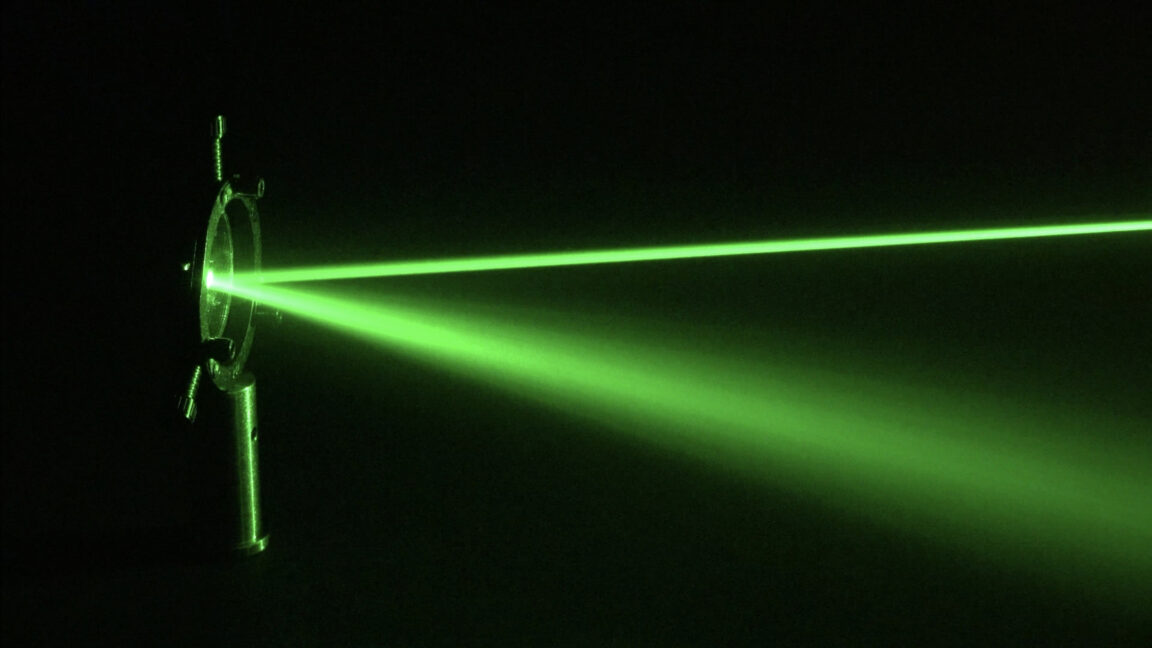
Physicists have entangled a glass bead with light, marking the first time a solid object large enough to be seen under a microscope has been linked at the quantum level to a beam of photons, according to research published this week. The experiment demonstrates that objects thousands of times more massive than atoms can exhibit entanglement — the phenomenon in which two particles share a single quantum state no matter how far apart they are.
The team suspended the bead in a laser trap, using focused light to hold it in place while a second light field interacted with the bead's motion. When the two fields were measured together, their quantum states were correlated in a way that classical physics cannot produce, the researchers reported. The result appeared in the journal Science.
Entanglement is the backbone of quantum computing and quantum cryptography. Two particles that are entangled behave as a single system: measuring one instantly determines the state of the other. Until now, entanglement had been demonstrated mainly between photons, atoms, and small molecules — objects far too tiny to observe directly.
The glass bead in the experiment measures roughly 100 nanometers across, about a thousandth the width of a human hair. It is small enough to be governed by quantum mechanics but large enough to be manipulated with precision optics, making it a bridge between the quantum and classical worlds.
The work builds on a decade of advances in "optomechanics," a field that uses light to control the motion of mechanical objects. In 2021, a separate team at the Delft University of Technology in the Netherlands reported entanglement between two vibrating membranes. The new experiment entangles a single bead with light itself, a configuration that may be easier to scale into larger quantum networks.
Such systems could one day test whether gravity itself has quantum properties — a question that has resisted experimental attack since the 1930s. A bead massive enough to feel gravity but still quantum-entangled would let physicists probe where the quantum rules break down.
The experiment required isolating the bead from vibrations, stray electric fields, and thermal noise. The team cooled the setup to near absolute zero and shielded it inside a vacuum chamber. Even a single gas molecule striking the bead would destroy the entanglement.
"This is a tour-de-force experiment," said one physicist familiar with the work, who was not involved in the research. The result, the researcher added, moves quantum mechanics from the microscopic realm into territory that can be seen and manipulated.
Practical applications remain years away. Quantum computers built on entangled photons still struggle with error rates, and a mechanical bead offers no immediate advantage over existing qubit designs. But the experiment gives physicists a new platform for testing quantum theory at scales never before accessible.