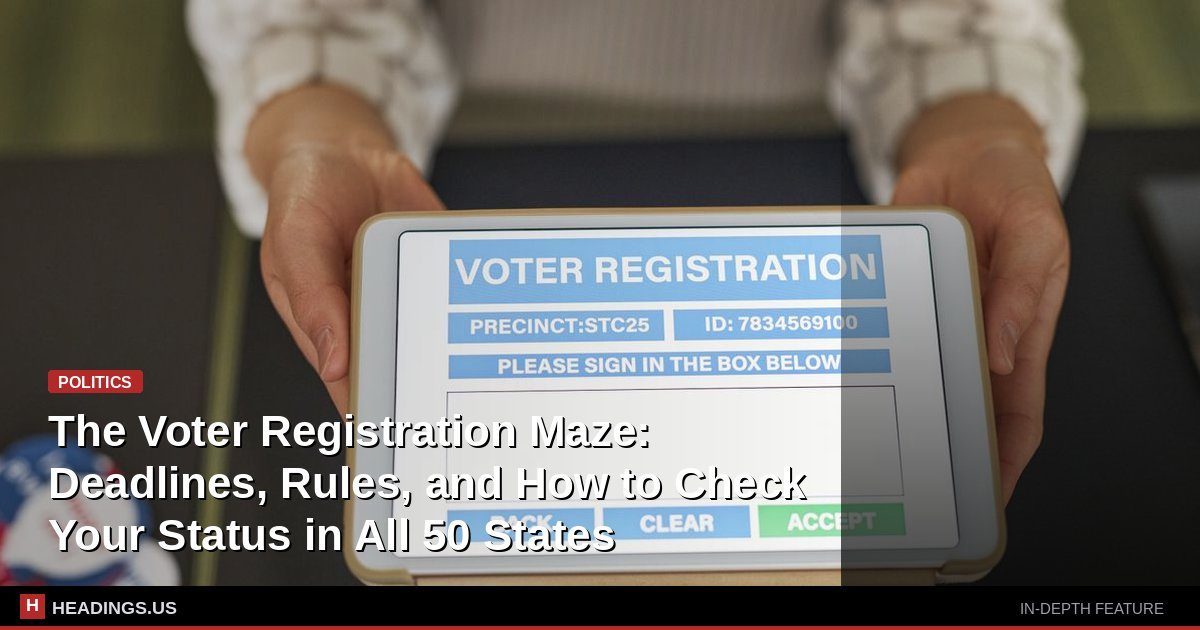
In most democracies, the government registers you to vote. In the United States, the burden falls on you. That single design choice explains why roughly one in four eligible Americans is not registered to vote, according to estimates from the Pew Research Center, and why the rules for fixing that can differ dramatically depending on which side of a state line you live on.
The result is a patchwork of deadlines, identification requirements, and verification systems that confuses even seasoned political operatives. A voter who moves from Oregon to Texas can go from automatic registration to a system that requires a stamped form arriving weeks before an election. Understanding those differences is the first step toward making sure your ballot actually counts.
Why the System Looks This Way
The Constitution leaves election administration to the states, and states have guarded that power fiercely. The Help America Vote Act of 2002, passed after the disputed 2000 presidential election, set minimum standards and required every state to maintain a computerized statewide voter list. But it did not create a national registry, and Congress has never mandated one.
What emerged instead is a system where the federal government sets some floor requirements, states fill in the rest, and local county clerks do the actual work of processing forms. The Brennan Center for Justice has documented that registration deadlines alone range from same-day registration in more than 20 states to cutoffs as early as 30 days before an election in others.
The Three Basic Deadlines
Every state falls into one of three categories for when you must register.
- Same-day or Election Day registration. States including Maine, Minnesota, Wisconsin, Colorado, and California allow voters to register and cast a ballot on the same day, either at polling places or at designated vote centers. This is the most forgiving system.
- A short window. Many states cut off registration between 7 and 15 days before an election. Florida, for example, requires registration 29 days before a general election, while Virginia closes its books 22 days out.
- A long lead time. A handful of states, including Arkansas and Rhode Island, require registration up to 30 days before an election. Miss it and your only option is an absentee ballot in a future contest.
The practical takeaway: if you are unsure of your state's deadline, assume it is earlier than you think and register now. The U.S. Election Assistance Commission publishes a state-by-state deadline chart that is updated each cycle.
How to Register
There are more paths onto the rolls than most people realize.
The most common is the National Mail Voter Registration Form, a document the Election Assistance Commission maintains that works in most states. You can print it, fill it out, and mail it to your local election office. Some states require the form to be postmarked, not received, by the deadline, so check the fine print.
Most states also offer online registration through their secretary of state or election office website. The National Conference of State Legislatures tracks which states allow it. Online registration typically requires a state-issued driver's license or identification card number, which is how the state verifies your identity against motor vehicle records.
Under the National Voter Registration Act of 1993, often called the Motor Voter law, you can also register when you apply for or renew a driver's license, when you apply for public assistance, or at many military recruitment offices. And if you have recently become a U.S. citizen, you can register at your naturalization ceremony in many jurisdictions.
The single biggest reason registration fails is not fraud or suppression. It is that people move and forget to update their address.
The Movers Problem
About 13 percent of Americans change residences each year, according to Census Bureau data. Every move creates a registration problem. If you move within the same county, your registration usually transfers automatically or with a quick update. If you cross county or state lines, you generally must re-register.
Some states, including Oregon and Colorado, have adopted automatic voter registration systems that update your record when you interact with the DMV. Others, like Texas and Georgia, do not, and a voter who moves and fails to update can show up at the polls only to find their name has been flagged for removal.
Federal law requires election officials to send a confirmation notice before removing a voter for a change of address, and voters who respond can stay on the rolls. But those notices are easy to miss, and a failure to respond can trigger removal after two federal election cycles.
How to Check Your Status
Checking your registration takes about two minutes and is the most useful thing you can do before an election.
Nearly every state offers an online voter lookup tool, usually hosted by the secretary of state or county election office. You enter your name, date of birth, and sometimes the last four digits of your Social Security number, and the system tells you whether you are registered, your polling location, and your sample ballot.
If your state does not offer an online tool, call your county clerk or election administrator directly. They can confirm your status over the phone and tell you what to bring if you need to register at the polls.
If you find that you are not registered, or that your address is wrong, you can usually fix it online or by mail before the deadline. If the deadline has passed, ask whether your state allows same-day registration or a provisional ballot, which lets you vote and have your eligibility verified afterward.
What Happens When You Show Up
Even registered voters can hit snags at the polling place. Identification requirements vary. Some states, like Wisconsin and Indiana, require a photo ID. Others accept a utility bill, bank statement, or paycheck. A few, including California and Illinois, generally do not require identification from voters who registered in person.
If your name is not on the rolls, you are entitled to ask for a provisional ballot under federal law. Election officials then check your registration and count the ballot if you were eligible. Provisional ballots are not always counted, though. In some states, they are rejected if cast in the wrong precinct, so ask a poll worker for help finding the right location.