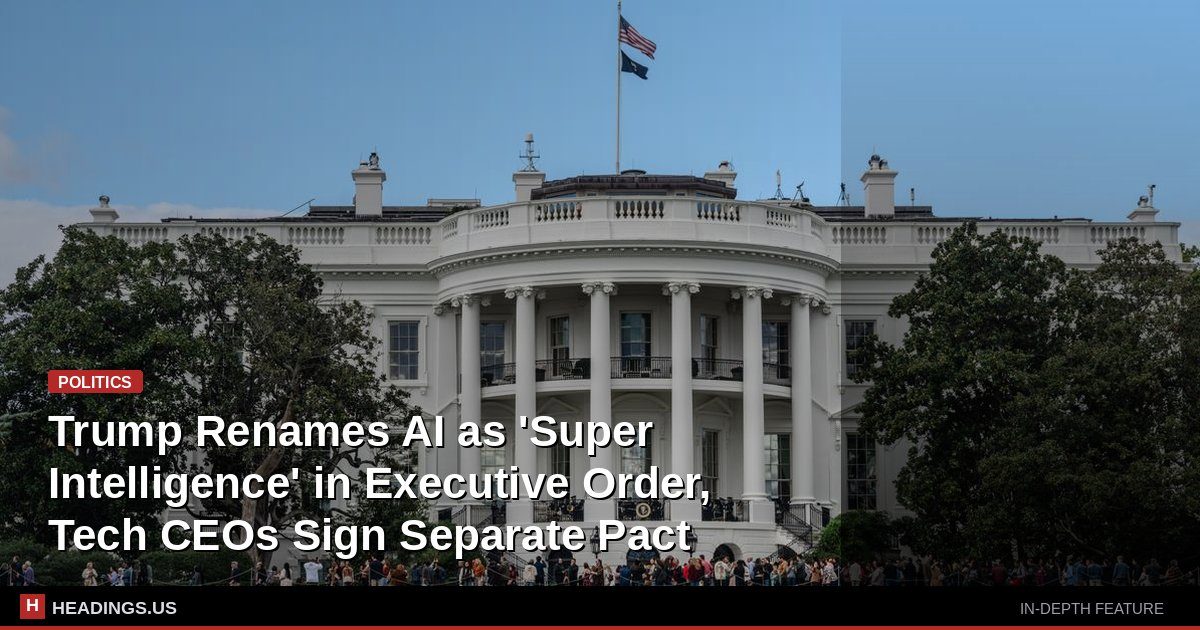
President Donald Trump signed an executive order Wednesday rebranding artificial intelligence as "Super Intelligence" across federal agencies, a move that immediately drew scrutiny from lawmakers and industry observers who questioned the scope and legal basis of the change.
The order directs federal departments and agencies to replace the term "artificial intelligence" with "Super Intelligence," or SI, in official documents, regulations, and public communications. Administration officials said the change reflects the growing capabilities of modern AI systems and aims to position the United States as the global leader in the field.
"We're not just talking about artificial intelligence anymore," Trump said during the signing ceremony in the Oval Office. "This is super intelligence. It's stronger, it's faster, and it's going to keep America number one."
Hours after the order was signed, several major technology companies announced they had signed a separate "SI Accord," a voluntary agreement outlining safety standards and development guidelines for advanced AI systems. The companies involved did not include the term "Super Intelligence" in their own announcement, instead using "advanced AI systems" throughout their statement.
The dual announcements raised questions about coordination between the White House and the private sector. A senior administration official, speaking on condition of anonymity, said the executive order and the industry accord were "complementary but independent" efforts.
Critics said the rebranding could create confusion in federal procurement, research funding, and international cooperation. The term "artificial intelligence" is embedded in decades of legislation, academic literature, and international treaties.
"Changing a name doesn't change the technology," said Sen. Mark Warner, D-Va., a member of the Senate Intelligence Committee. "What matters is whether we have real rules and real resources behind AI development and safety. This looks like branding, not policy."
The executive order does not allocate new funding or create new regulatory authority, according to a copy reviewed by reporters. It instructs agencies to update terminology within 90 days and to report back on implementation.
Tech industry groups offered mixed reactions. The Information Technology Industry Council said it appreciated the administration's focus on American competitiveness but urged Congress to pass AI legislation rather than rely on executive action alone.
The order comes as Congress remains divided on AI regulation. Several bipartisan bills have stalled in committee, including proposals to require safety testing for advanced models and to create a federal AI oversight board.
It was not immediately clear whether the name change would affect existing federal contracts, grant programs, or international agreements. The White House did not respond to questions about the estimated cost of implementing the rebranding across agencies.