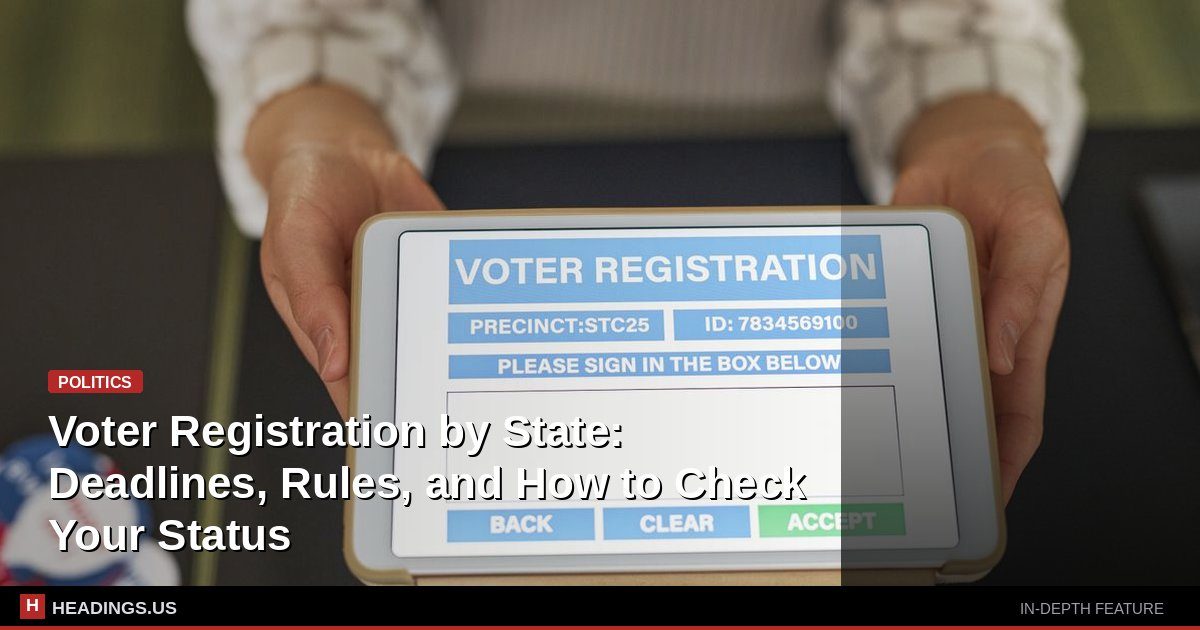
Registering to vote in the United States is not one process. It is 50 different processes, plus the District of Columbia and several territories, each with its own deadline, its own paperwork, and its own rules about who qualifies. A voter who moves from Texas to California can lose their registration without realizing it. A student who registers in one college town may find their name purged two years later. Understanding the map matters more than most people think.
The stakes are concrete. In the 2020 presidential election, roughly 168 million Americans were registered to vote and about 158 million cast ballots, according to U.S. Census Bureau data. That gap of millions represents people who were eligible but not registered, or registered but blocked by a deadline they missed. In the 2022 midterms, turnout dropped to about 112 million. Registration is the gate everyone has to pass through first.
Why Voter Registration Rules Differ So Much by State
The Constitution leaves the mechanics of elections to the states. Article I, Section 4 gives state legislatures the power to set the "Times, Places and Manner" of elections, and Congress can override that only through federal law. That is why a federal deadline for voter registration does not exist. Every state sets its own cutoff, and those cutoffs range from about a month before Election Day to the day itself.
Most states require registration 15 to 30 days before an election. Virginia, for example, historically closed registration 21 to 22 days out. Ohio uses 30 days. New York uses 25 days. But a growing bloc of states allows same-day registration, meaning you can register and vote in a single visit to a polling place or election office. As of recent election cycles, more than 20 states plus D.C. offer some form of same-day or Election Day registration, according to the National Conference of State Legislatures.
The result is a patchwork that punishes people who assume the rules are uniform. A mover who registers in one state on a Friday may be fine, then move across a border and miss the deadline entirely.
The Three Main Types of Registration Systems
States fall into rough categories based on how easy they make it to get on the rolls.
1. Deadline states
These states require you to register well before Election Day, typically 15 to 30 days. Miss the cutoff and you cannot vote in that election, no exceptions for most voters. Examples include Ohio, Virginia, New York, and Florida, though Florida allows some in-person changes during early voting.
2. Same-day and Election Day registration states
These states let you register and vote at the same time, usually at a polling place or county election office. The list includes California, Colorado, Illinois, Maine, Minnesota, Nevada, New Hampshire, Wisconsin, Wyoming, and others. Some require you to bring proof of identity and residency. Same-day registration is linked to higher turnout. A study published in the American Political Science Review found that same-day registration can raise turnout by several percentage points, especially among younger and lower-income voters.
3. Automatic and opt-out registration states
About 20 states plus D.C. have automatic voter registration, often called AVR, where eligible citizens are registered or have their information updated when they interact with a government agency like the DMV. Oregon was the first, passing it in 2015. Since then, states including California, Colorado, Georgia, and Massachusetts have adopted versions. The idea is to make registration the default rather than an extra step. Early evidence suggests AVR adds hundreds of thousands of registrants per state over a few years.
Key Deadlines and Rules to Know State by State
Here is a snapshot of how some of the largest states handle registration. Deadlines can shift, so always confirm with your state or county election office.
- California: Online registration closes 15 days before an election, but conditional voter registration lets you register and vote provisionally at a county office or polling place through Election Day.
- Texas: Registration closes 30 days before an election. Texas does not offer online registration for first-time voters, though you can print a form and mail it. This is one of the strictest deadlines in the country.
- Florida: Registration closes 29 days before an election. Florida offers online registration but no true same-day registration for most voters.
- New York: Registration closes 25 days before an election for mail and online, though in-person registration at a county board is allowed closer to the election in some cases.
- Ohio: Registration closes 30 days out. Ohio allows online registration but no same-day registration.
- Colorado: Same-day registration through Election Day. Colorado also mails ballots to every registered voter, which is why it consistently ranks near the top for turnout.
- Georgia: Registration closes 29 days before an election. Georgia has automatic registration through the DMV but no same-day registration.
- Pennsylvania: Registration closes 15 days out. Pennsylvania added automatic registration at the DMV in recent years.
Notice the range: from 30 days in Texas and Ohio to same-day in Colorado. That difference can decide whether a newly moved worker, a first-time voter, or a student can participate at all.
How to Register and How to Check Your Status
Registering is usually free and takes a few minutes online in most states. The federal government runs Vote.gov, which links to each state's official registration page. You can also register in person at a DMV, a county election office, a public library, or an armed forces recruitment center, depending on the state. Many states allow registration by mail using the National Mail Voter Registration Form, which covers most states but not all.
What you need varies. Most states ask for a driver's license number, a state ID number, or the last four digits of your Social Security number. If you have none of those, some states let you provide a utility bill, bank statement, or paycheck as proof of identity. First-time voters who register by mail may need to show ID at the polls under the Help America Vote Act.
Checking your status is just as important as registering. Voter rolls get updated, and people who have not voted in several election cycles can be flagged as inactive. In some states, that leads to removal if they skip a few federal elections. You can check your registration status through your state's election website or through Vote.org. Do it at least a month before an election, not the week of.
Roughly one in four eligible Americans is not registered to vote, according to estimates from the Pew Charitable Trusts. Many of them believe they are registered.
Common Mistakes That Cost People Their Vote
The most frequent problem is a move. If you change your address, your registration does not automatically follow you in most states. You have to update it, and if you cross a county or state line, the deadline may already have passed. Update your registration as soon as you get a new address, even if no election is near.
The second problem is a name mismatch. If your registration says "Bob" but your ID says "Robert," some states will turn you away or make you vote provisionally. Register under the name that matches your government ID. The third issue is inactive status. If you skip a couple of elections and do not respond to a confirmation notice, some states move you to inactive. You may still be able to vote, but you may have to re-register or confirm your address at the polls.
Students face a specific trap. You can usually register at your campus address or your parents' address, but not both. Pick one and stick with it. Registering in a college town and then moving home for the summer can leave you registered in a place you no longer live.
Practical Takeaways
- Check your registration status now, not the week before an election. Use your state's official election site or Vote.org.
- Find your state's deadline. If it is 30 days out, set a calendar reminder for 45 days out to give yourself a buffer.
- Update your registration every time you move, even across town.
- Register under the exact name on your driver's license or state ID.
- If your state offers same-day registration, you still save time by registering early, but you have a safety net if you miss the deadline.
- If you register by mail as a first-time voter, plan to bring ID to the polls.
- Keep a screenshot or confirmation email of your registration. It is useful if a poll worker cannot find your name.
Voter registration is not glamorous, and it is not the same anywhere. But it is the one step that determines whether everything else, from early voting to mail ballots to showing up on Election Day, is even possible. The rules are public, the deadlines are posted, and the tools to check your status are free. The only thing that makes them hard is waiting until it is too late.