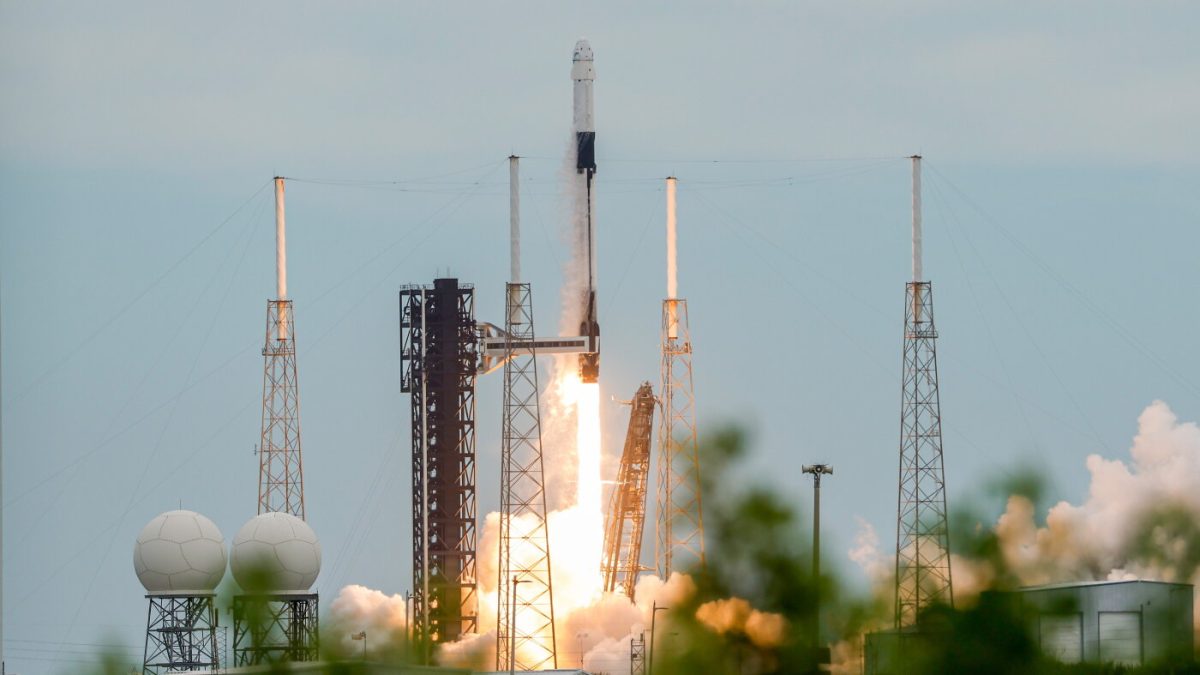
A SpaceX Falcon 9 rocket lifted off from NASA's Kennedy Space Center in Florida on Friday, carrying four astronauts aboard a Crew Dragon capsule bound for the International Space Station.
The crew will spend roughly six months aboard the orbiting laboratory, conducting scientific research and maintaining the station's systems. The launch marks the latest rotation of personnel under NASA's Commercial Crew Program, which since 2020 has relied on SpaceX to ferry astronauts to and from low Earth orbit.
The Crew Dragon capsule, named by its crew ahead of the flight, separated from the Falcon 9's second stage minutes after liftoff and fired its thrusters to begin the roughly 24-hour journey to the station. The capsule is scheduled to dock autonomously at a port on the station's Harmony module, where the arriving crew will be greeted by the astronauts already aboard.
SpaceX has now flown multiple operational crew rotations for NASA since the company's first crewed demonstration flight in May 2020, when astronauts Bob Behnken and Doug Hurley flew Dragon to the station and returned safely two months later. That mission restored human launch capability from U.S. soil for the first time since the space shuttle program ended in 2011.
The Falcon 9's first stage returned to a landing pad at Cape Canaveral after separation, part of SpaceX's effort to reuse rocket hardware and lower launch costs. The booster used Friday had flown on previous missions, according to the company.
NASA has increasingly leaned on the station as a platform for research that supports its Artemis program, which aims to return astronauts to the lunar surface. Studies conducted in microgravity on the station inform everything from drug development to understanding how the human body responds to long-duration spaceflight.
The incoming crew will join a rotating complement of astronauts and cosmonauts already conducting experiments in biology, physics, and materials science. Station crews typically overlap for several days during handover, briefing one another on ongoing experiments and maintenance tasks before the departing astronauts board their own capsule for the ride home.
Weather conditions at the Florida launch site were favorable in the hours before liftoff, and launch controllers reported no technical issues during the countdown. The flight proceeded on schedule after a smooth fueling sequence.
SpaceX recovery teams were positioned in the Atlantic Ocean in the event of an emergency abort, a standard precaution for crewed launches. The company's Dragon capsules are equipped with an escape system designed to pull the spacecraft away from the rocket in the event of a failure during ascent.
The mission is expected to conclude with a splashdown off the Florida coast, where recovery vessels will retrieve the capsule and its crew.