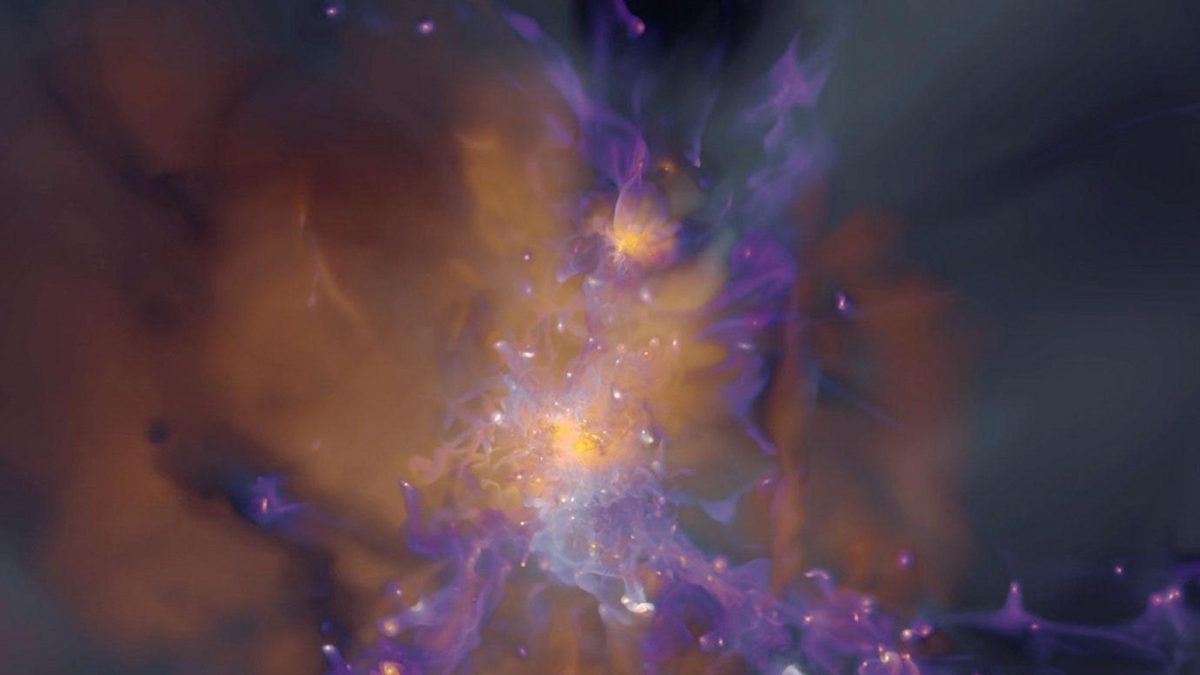
The Milky Way was built from thousands of smaller protogalaxies that merged over billions of years, not from a handful of large galactic collisions as long assumed, according to new computer simulations reported by Live Science.
The finding challenges the standard model of galaxy formation, which has long held that the Milky Way grew primarily through mergers with a few massive satellite galaxies. The simulations instead point to a gradual assembly process involving a much larger number of small building blocks.
Each of those protogalaxies would have contained its own population of stars, gas, and dark matter before being pulled together by gravity into the structure astronomers observe today. The Milky Way's roughly 100 billion to 400 billion stars and its estimated 100,000-light-year diameter are the end product of that long accumulation.
Astronomers have known since the 1970s that galaxies grow through hierarchical merging — small structures forming first and combining into larger ones. What the new work adds is the scale: the count of distinct progenitor objects runs into the thousands, far above earlier estimates.
The simulations rely on modeling gravity, gas dynamics, and dark matter interactions across cosmic time. Dark matter, which makes up roughly 85 percent of the matter in the universe but emits no light, provides the gravitational scaffolding that draws protogalaxies together.
Evidence for past mergers is already visible in the Milky Way's halo, the sparse spherical cloud of stars surrounding its flat disk. Astronomers have identified stellar streams — stretched-out ribbons of stars — that are the shredded remains of dwarf galaxies consumed by the Milky Way. The Gaia space telescope, launched by the European Space Agency in 2013, has mapped the positions and motions of more than 1.8 billion stars and helped identify many of these remnants.
One well-documented example is Gaia-Enceladus, a galaxy roughly the mass of the Large Magellanic Cloud that merged with the Milky Way an estimated 8 billion to 10 billion years ago. That single event is thought to have contributed a large share of the stars now in the Milky Way's halo and helped thicken its disk.
If thousands of smaller protogalaxies were involved rather than a few large ones, the chemical fingerprints left in ancient stars should differ from current predictions. Metal-poor stars — those formed before successive generations of supernovae enriched the interstellar medium with heavier elements — serve as fossils of the earliest merger events.
The results carry implications beyond the Milky Way. If the same process operated in other galaxies, it would affect models of how spiral structure, galactic disks, and stellar halos develop across the universe. Future observations from Gaia and next-generation telescopes, including the Vera C. Rubin Observatory in Chile, are expected to test the simulations against the actual motions and chemistries of millions of stars.