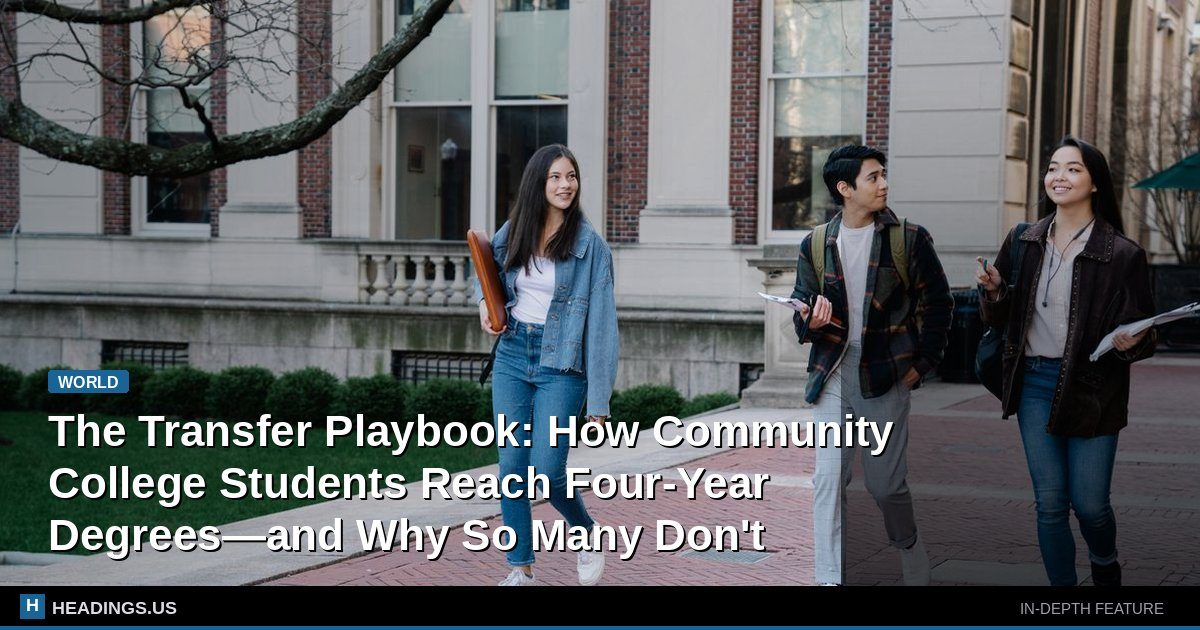
Roughly 8.5 million students are enrolled in America's public two-year colleges, according to the American Association of Community Colleges. That's close to half of all U.S. undergraduates. The pitch is simple: lower tuition, flexible schedules, a path to a bachelor's degree without six figures of debt.
The reality is messier. The Community College Research Center at Columbia University tracks what happens to students who say they want a bachelor's degree. About 80 percent of entering community college students intend to transfer. Only about 31 percent actually do within six years, and just 13 percent complete a bachelor's degree within that window.
That gap—between intention and outcome—is one of the most consequential leaks in American higher education. It costs students years of time, thousands of dollars, and in many cases, the career they were aiming for. But it isn't inevitable. The students who make it through tend to do a handful of specific things, and the colleges that push transfer rates up tend to share a few structural habits.
Why the Pipeline Leaks
The first problem is credit loss. A 2022 study from the Government Accountability Office found that students who transferred lost an average of 43 percent of their credits. That means a student who earned 60 credits at a community college—roughly two full years—might walk into a university with only 34 that count. Suddenly the "two-plus-two" plan becomes a five-year plan, and the math on cost savings falls apart.
Part of this is misalignment between institutions. A course called "Introduction to Statistics" at one school may not match the sequence at another. Part of it is bad advising. And part of it is students changing majors midway, which resets the clock no matter where you started.
The second problem is the "transfer shock" phenomenon—a term researchers have used since the 1960s to describe the dip in grades students often experience in their first semester after transferring. A student who earned a 3.6 GPA at a community college may find themselves earning a 2.9 at a four-year school, not because they're less capable but because the environment changed: larger classes, less hand-holding, different expectations around independent work.
What the Success Stories Have in Common
Consider the case of Yasmine Rodriguez, who graduated from Miami Dade College in 2019 and transferred to Florida International University. She finished her bachelor's in psychology in 2021 and is now a school counselor in Broward County. Her advice is blunt: "I picked my four-year school before I picked my classes."
That's the single most consistent piece of advice from transfer students who finish. They work backward. They identify the university and major they want, pull that school's transfer requirements, and build their community college schedule around those requirements—not around what's convenient or what a friend is taking.
Florida has made this easier than most states. The state's 2+2 system guarantees admission to a Florida public university for students who earn an Associate of Arts degree from a Florida College System institution, provided they meet certain GPA thresholds. The result: Florida's transfer rate from two-year to four-year public institutions runs well above the national average.
California has a similar architecture. The Associate Degree for Transfer (ADT) program, created in 2010, guarantees admission to a California State University campus for students who complete a specific set of courses. As of recent reporting, more than 400,000 students have earned an ADT, and the program has been credited with reducing excess credit accumulation—the number of credits students take beyond what's needed to graduate.
States With Strong Transfer Pipelines
- Florida: Guaranteed admission via the 2+2 system for A.A. graduates.
- California: Associate Degree for Transfer guarantees CSU admission.
- Virginia: Statewide transfer agreements cover most public four-year schools.
- Washington: Direct Transfer Agreement (DTA) provides junior standing at public universities.
- Texas: Core curriculum transfer guarantees credit for 42 semester hours.
If you live in one of these states, the path is clearer than it's ever been. If you don't, you'll need to do more of the work yourself—but the work is doable.
The Practical Playbook
Here's what transfer students who finish actually do, based on research from the Community College Research Center, the Jack Kent Cooke Foundation, and interviews with transfer advisors.
1. Choose the destination first. Before you register for your first community college class, identify two or three four-year schools and the major you're targeting. Pull their transfer credit policies. Most schools publish a "transfer equivalency" tool that shows exactly which community college courses count for which requirements. Use it.
2. Get the associate degree. Even if you don't need it, finish it. Students who earn an A.A. or A.S. before transferring are significantly more likely to complete a bachelor's. The degree also often satisfies general education requirements at four-year schools in the same state, which reduces credit loss.
3. Meet with a transfer advisor every semester. Not a general academic advisor—a transfer-specific one. Many community colleges have dedicated transfer centers. Students who use them transfer at higher rates. Bring your target school's requirements to every meeting.
4. Protect your GPA. Most transfer scholarships and guaranteed admission programs have GPA thresholds, often 2.5 or 3.0. A single bad semester can close doors. If you're struggling, drop the class before the deadline rather than taking the grade.
5. Apply early and apply broadly. Transfer application deadlines are often different from freshman deadlines, and many schools have limited transfer slots. Apply to at least three schools, including one safety.
"The students who transfer successfully are the ones who treat it like a project, not a hope. They have a spreadsheet. They know the deadlines. They know which credits count." — Dr. Linda Serra Hagedorn, professor emerita, Iowa State University, who has studied transfer student outcomes for three decades
Money Matters More Than Most Students Think
The financial case for starting at a community college is real. Average published tuition and fees at public two-year colleges run around $3,900 per year, compared with roughly $11,000 at public four-year schools and nearly $40,000 at private nonprofits, according to the College Board's Trends in College Pricing. But the savings only materialize if you transfer efficiently.
Extra semesters erase the advantage. A student who saves $7,000 per year for two years but then takes an extra year at the university because of lost credits has saved nothing. The playbook isn't just about getting in—it's about getting out on time.
There's also the transfer scholarship question. Many four-year schools reserve specific scholarships for transfer students, and some states offer transfer-specific grant programs. The Jack Kent Cooke Foundation's Undergraduate Transfer Scholarship, for example, awards up to $55,000 per year to high-achieving community college students transferring to four-year institutions. It's competitive—roughly 100 recipients a year from thousands of applicants—but it exists, and most community college students never apply.