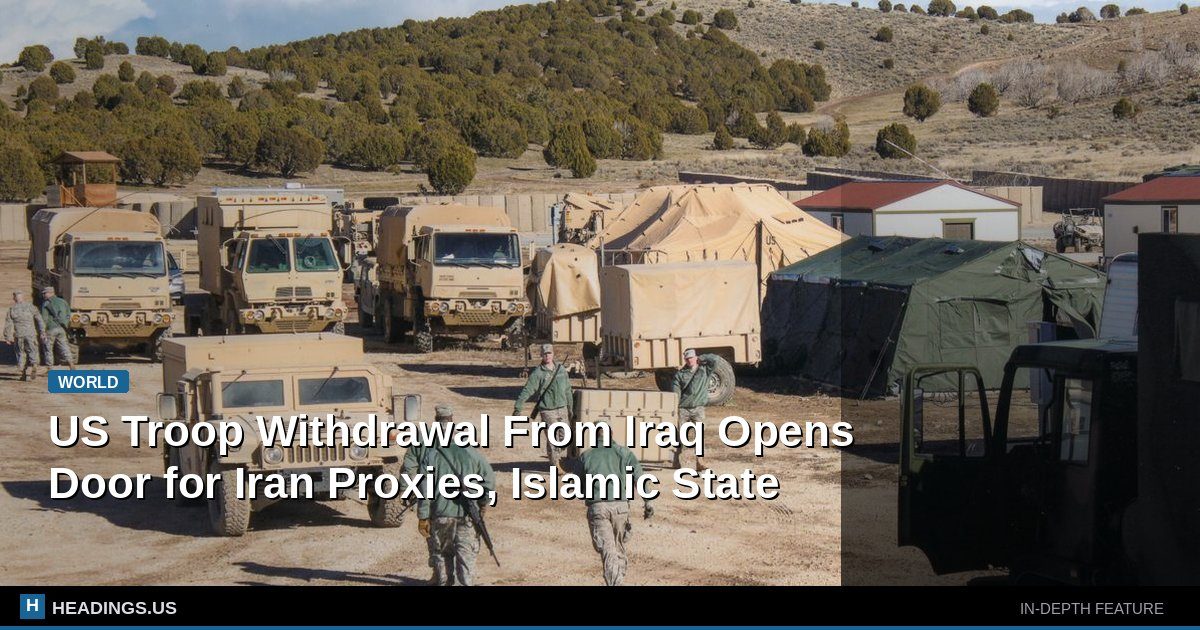
American forces have completed their withdrawal from Iraq, leaving a security vacuum that Iran-backed militias and Islamic State remnants are already exploiting, according to defense officials and regional analysts.
The pullout, which concluded this week, ends nearly two decades of US military presence in the country. It fulfills a long-standing demand from Iraqi political factions aligned with Tehran, who pushed for a timetable after the 2020 killing of Iranian General Qassem Soleimani in Baghdad.
Iran-backed militias, including Kataib Hezbollah and other factions of the Popular Mobilization Forces, have expanded their footprint across Anbar and Diyala provinces in recent weeks, according to security monitors. These groups now control key checkpoints and supply routes that US troops once patrolled.
"The Iranians don't need to fire a shot," said Michael Knights, a senior fellow at the Washington Institute for Near East Policy. "Their proxies simply walk into the space we left behind."
Islamic State cells have also stepped up attacks. The group claimed responsibility for three bombings in northern Iraq this month, killing at least 22 people. US military officials warned repeatedly before the withdrawal that Iraqi security forces were not ready to hold ground without American air support and intelligence.
Iraq's military numbers roughly 200,000 active personnel, but units remain plagued by corruption, poor logistics, and sectarian divisions. Kurdish Peshmerga forces in the north operate largely outside Baghdad's command, creating gaps that militants have exploited before.
The withdrawal also complicates US counterterrorism operations in neighboring Syria, where about 900 American troops remain. Those forces relied on Iraqi bases for logistics and medical support. Military planners are now scrambling to reroute supply lines through Jordan and Kuwait, adding cost and delay.
Regional reaction has been swift. Israeli officials privately expressed alarm, warning that a stronger Iranian presence in Iraq brings Tehran closer to establishing a land bridge connecting Iran to Lebanon and the Mediterranean. Saudi Arabia and the UAE have quietly increased defense spending in response.
In Washington, lawmakers from both parties criticized the exit. Senator Lindsey Graham called it "a strategic blunder that will be paid for in American blood later." The White House defended the move, saying Iraq's government requested the departure and that the US retains the ability to strike terrorist targets from outside the country.
What happens next depends largely on whether Iraq's fractured political leadership can hold its military together. Past withdrawals, including the 2011 US exit, were followed by the rapid rise of Islamic State and the need to send troops back. Whether that history repeats itself is now the central question facing the region.