A fifth unvaccinated person has died from measles in the United States, marking the highest death toll from the disease since it was declared eliminated in 2000, as the Centers for Disease Control and Prevention confirms it is not counting every measles-related death.
State health officials are racing to contain outbreaks, administering more than 8,500 vaccine doses in emergency response efforts. The deaths have occurred across multiple states, with the CDC acknowledging that its official count may understate the true toll because it relies on state-reported data that varies in completeness.
The measles virus is one of the most contagious known to science — it can linger in the air for up to two hours after an infected person leaves a room, and one case can infect up to 18 unvaccinated people. Before the measles vaccine was introduced in 1963, the disease killed an estimated 400 to 500 Americans annually and hospitalized 48,000 each year.
The U.S. achieved measles elimination status in 2000, a milestone that required sustained vaccination rates above 95% with two doses of the MMR vaccine. That status is now at risk. A country loses elimination status when measles spreads continuously for 12 months within its borders.
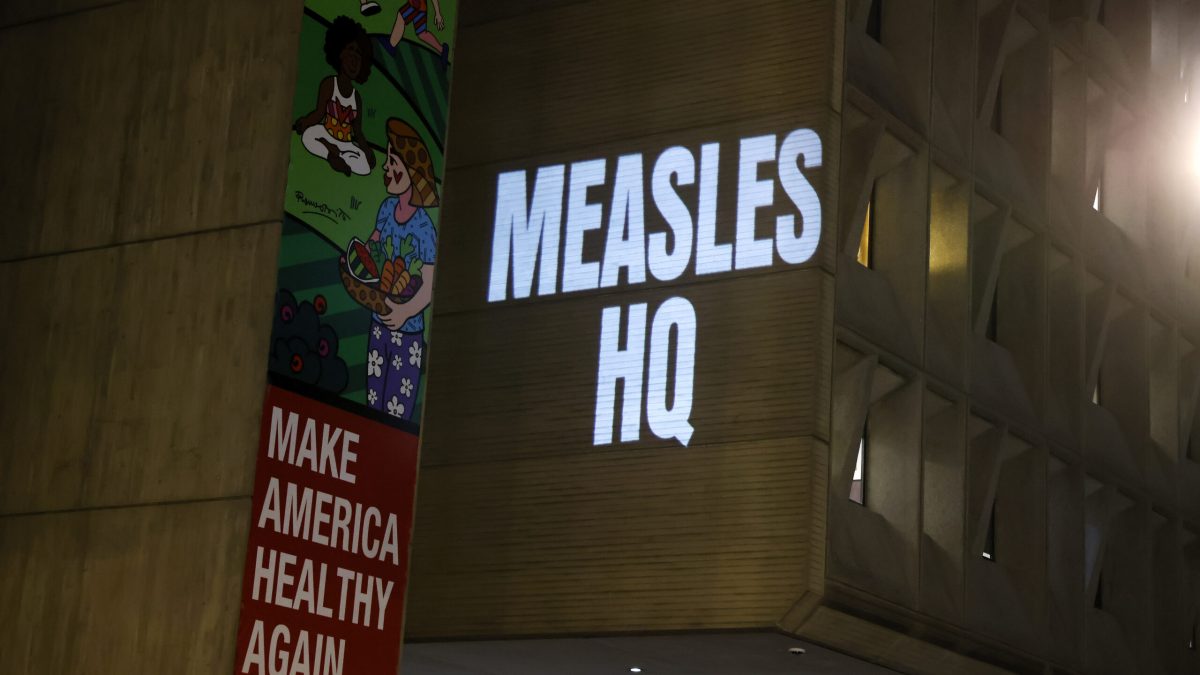
Protect Our Care, a health care advocacy group, projected a message onto the U.S. Department of Health and Human Services headquarters in Washington, D.C., criticizing HHS Secretary Robert F. Kennedy Jr. over his handling of the outbreak. Kennedy has previously questioned the safety of the measles vaccine and promoted alternative treatments like vitamin A and cod liver oil, which public health officials say do not prevent measles infection.
The MMR vaccine is 97% effective at preventing measles after two doses. The first dose is recommended at 12 to 15 months of age, with the second dose at 4 to 6 years. Adults born after 1957 who have not been vaccinated should receive at least one dose.
Measles symptoms typically appear 10 to 14 days after exposure and include high fever, cough, runny nose, red eyes, and a rash that spreads from the face downward. Complications include pneumonia, encephalitis, and death. There is no antiviral treatment for measles — medical care focuses on managing symptoms and complications.
The CDC reported more than 1,200 measles cases in 2019, the largest outbreak in 27 years, concentrated in undervaccinated communities in New York. That outbreak cost New York City an estimated $8.4 million in public health response expenses. The current outbreak has already surpassed case counts from recent years, with health departments in Texas, New Mexico, and other states reporting active transmission chains.
Kennedy, who was confirmed as HHS secretary in February 2025, has said he encourages vaccination but has also promoted unproven treatments and appointed vaccine skeptics to advisory roles. The CDC's vaccine advisory committee is scheduled to review its measles recommendations, though no date has been set.