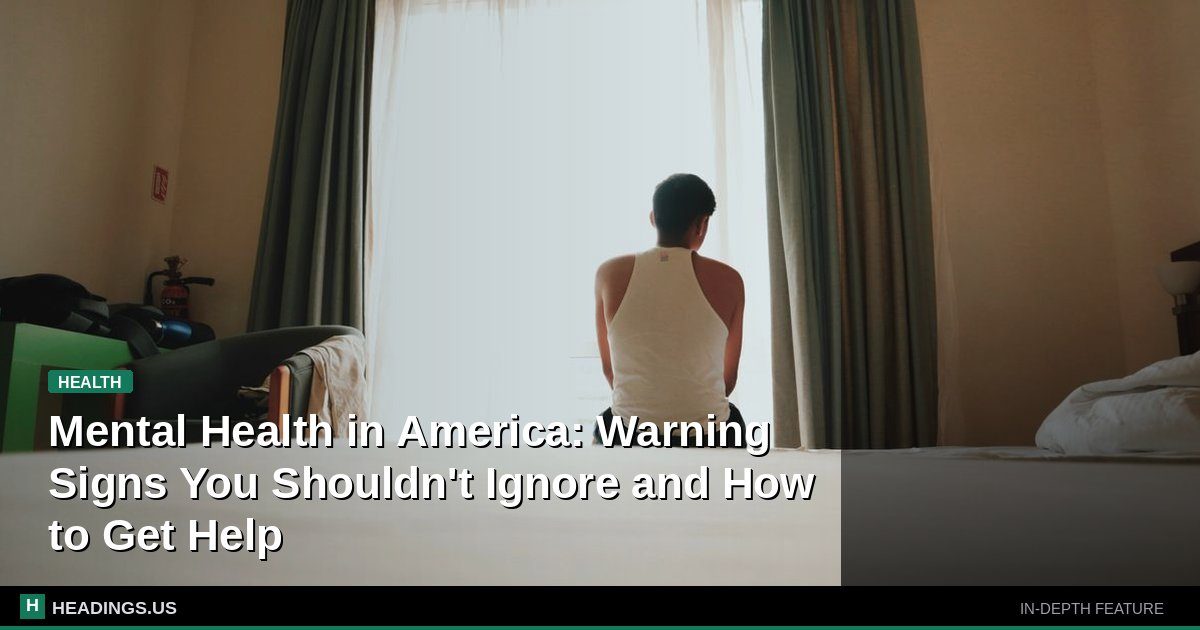
Almost everyone knows someone who is struggling. They might be a coworker who jokes about running on caffeine and no sleep. A teenager who quit the soccer team and rarely leaves her room. A father who lost interest in the garage projects he once loved. In America, mental health struggles are not rare exceptions. They are part of daily life for tens of millions of people.
The numbers tell a story most of us sense but rarely say out loud. According to the National Institute of Mental Health, more than one in five American adults lives with a mental illness in any given year. That is roughly 59 million people. Nearly 1 in 20 adults — about 15 million — experience serious mental illness that interferes with major life activities. Among teenagers, the picture is just as sobering: the CDC reports that about 4 in 10 high school students have felt persistently sad or hopeless.
What makes this a national problem is not just the prevalence. It is the gap between people who need help and people who get it. The Substance Abuse and Mental Health Services Administration (SAMHSA) estimates that fewer than half of adults with a mental illness receive any treatment. Cost, stigma, long waitlists, and plain confusion about where to start keep millions of people stuck.
This guide covers what to watch for, how to tell the difference between a bad week and something more serious, and the concrete steps to find care — including free and low-cost options that most people never hear about.
What Mental Health Warning Signs Actually Look Like
Movies and TV often show mental illness as dramatic: a breakdown, a hospital scene, a crisis. Real life is quieter. Most warning signs show up gradually, and they often look like personality changes or physical complaints rather than obvious emotional distress.
Mental health professionals look for patterns that last two weeks or longer and that interfere with work, school, relationships, or basic self-care. The key word is interfere. Everyone has rough days. The question is whether the rough days are stacking up and shrinking your life.
Common warning signs in adults include:
- Withdrawal. Turning down invitations, ignoring texts, and pulling away from friends and family.
- Sleep changes. Sleeping far more or far less than usual, or waking at 3 a.m. with racing thoughts.
- Loss of interest. Activities that once brought joy — cooking, fishing, reading, sex — feel flat or pointless.
- Irritability and anger. Snapping at small things, road rage, or a short fuse that wasn't there before.
- Physical symptoms. Headaches, stomach problems, chronic fatigue, or unexplained aches that doctors can't trace to a physical cause.
- Difficulty functioning. Missing deadlines, letting bills pile up, or struggling to do tasks that used to be automatic.
- Hopelessness. Talk of being a burden, feeling trapped, or believing things will never improve.
- Substance use. Drinking or using drugs to manage mood, sleep, or stress.
Teenagers and young adults often show different signs. Watch for a drop in grades, skipping class, withdrawing from sports or clubs, changes in friend groups, risky behavior, or persistent irritability rather than sadness. Younger children may complain of stomachaches, act out at school, or regress on milestones like sleeping through the night.
If you notice a cluster of changes lasting more than two weeks, that is your signal to take it seriously — not to wait for things to get worse.
When It's More Than a Bad Week: Depression, Anxiety, and Other Conditions
Mental health conditions are not one thing. They are dozens of distinct diagnoses, and each has its own pattern. The most common in the U.S. are anxiety disorders (about 19% of adults each year, per NIMH) and major depressive disorder (roughly 8%). Others include bipolar disorder, PTSD, OCD, and schizophrenia.
Knowing roughly what you're dealing with helps you ask better questions and find the right specialist. A few distinctions matter:
Depression vs. sadness
Sadness is a normal response to loss. Depression is persistent, lasts most of the day for weeks, and often arrives without a clear trigger. It also comes with physical symptoms — appetite changes, sleep problems, low energy — that pure sadness usually doesn't.
Anxiety vs. stress
Stress has a cause and eases when the cause goes away. Anxiety often has no clear trigger, or the worry is out of proportion to the situation. It can show up as panic attacks, constant dread, or physical tension that never fully releases.
Grief vs. prolonged grief disorder
Grief is expected after a loss. When intense grief persists for more than a year in adults and disrupts daily life, it now has its own diagnosis and its own treatments.
One important warning: bipolar disorder is often missed because people seek help during a depressive episode, and the manic or hypomanic episodes are not mentioned. If you've had periods of unusually high energy, little need for sleep, and impulsive decisions, tell your doctor. It changes the treatment plan.
How to Find Mental Health Care in the U.S.
The single biggest barrier most people hit is not knowing where to start. Here is a practical map.
Start with your primary care doctor
This surprises people, but a family doctor or nurse practitioner can screen for depression and anxiety, prescribe common medications like SSRIs, and refer you to a therapist. If you're already seeing a doctor for anything, that visit is a low-pressure place to raise mental health. Many primary care offices now screen every adult patient with a short questionnaire.
Use SAMHSA's National Helpline
The Substance Abuse and Mental Health Services Administration runs a free, confidential, 24/7 treatment referral line at 1-800-662-HELP (4357). It serves people facing mental health or substance use issues and their families. Services are available in English and Spanish, and the line can connect you to local sliding-scale clinics.
Look for community health centers
Federally Qualified Health Centers (FQHCs) serve more than 30 million Americans and are required to offer mental health services, often on a sliding fee scale based on income. Find one at findhealthcenter.hrsa.gov. You do not need insurance to be seen.
Try telehealth, but check coverage
Telehealth exploded during the pandemic and remains a fast route to therapy, especially in rural areas where psychiatrists are scarce. Medicare, Medicaid, and most private plans now cover telehealth mental health visits. Platforms like Open Path Collective and the Therapy Aid Coalition offer discounted sessions for people who qualify.
If you have insurance, use it well
Call the member services number on your card and ask three questions: Is this provider in network? What is my copay for therapy and psychiatry? How many sessions are covered per year? Under the Mental Health Parity and Addiction Equity Act, most plans must cover mental health at the same level as physical health. If you're denied coverage, you can appeal — and appeals often succeed.
If you don't have insurance
Options include Medicaid (check your state's income limits — many states expanded eligibility), university training clinics that offer low-cost therapy supervised by licensed faculty, and 211, a nationwide service reachable by dialing 2-1-1 that connects callers to local resources.
What to Do in a Mental Health Crisis
When someone is in immediate danger of harming themselves or others, speed matters more than paperwork.
Call or text 988. The 988 Suicide and Crisis Lifeline launched as a national three-digit number and connects callers to trained counselors 24/7. It works for suicidal thoughts, emotional distress, and substance use crises. Veterans can press 1 for the Veterans Crisis Line.
Text HOME to 741741 to reach the Crisis Text Line. This is often easier for teenagers and young adults who don't want to talk on the phone.
Call 911 if there is an immediate physical threat, such as someone holding a weapon or actively attempting suicide. When you call, tell the dispatcher it is a mental health crisis and ask if a crisis intervention team (CIT) or mobile crisis unit is available. A growing number of cities dispatch mental health professionals instead of police for these calls.
If you are worried about a friend or family member, do not leave them alone, remove access to firearms and medications if possible, and stay with them until help arrives. Asking directly whether someone is thinking about suicide does not plant the idea. Research consistently shows it opens the door to honest conversation.
Practical Steps You Can Take This Week
Understanding the system is one thing. Acting on it is another. Here is what actually moves the needle.
- Take a free, validated screening. Mental Health America offers anonymous screenings at mhascreening.org for depression, anxiety, PTSD, and more. It takes about five minutes and gives you language to bring to a doctor.
- Write down what you're noticing. Track sleep, mood, appetite, and energy for two weeks. Patterns are more useful to a clinician than a single bad day.
- Tell one person. A friend, a pastor, a coach, a sibling. Isolation makes symptoms worse, and the simple act of saying it out loud reduces shame.
- Cut the alcohol. Alcohol is a depressant and disrupts sleep architecture. Many people notice mood improvements within a few weeks of reducing intake.
- Move your body. Regular aerobic exercise has effect sizes comparable to medication for mild to moderate depression in multiple studies. Even a 20-minute walk counts.
- Protect sleep. Consistent wake times, no screens an hour before bed, and a cool dark room. Sleep and mental health are tightly linked in both directions.
- Set one small boundary. A job that demands 60-hour weeks, a relationship that drains you, or a family obligation you dread — pick one and change it.
The most important takeaway is this: mental health conditions are treatable. Depression, anxiety, PTSD, and bipolar disorder all have evidence-based treatments with good outcomes. Most people who get care improve. The hardest part is usually the first phone call.
If you have been waiting for a sign, this is it. You do not need to hit rock bottom to deserve help. You do not need a diagnosis to talk to someone. And you do not have to figure out the system alone — 988, 211, and 1-800-662-HELP exist precisely because millions of Americans need a place to start.