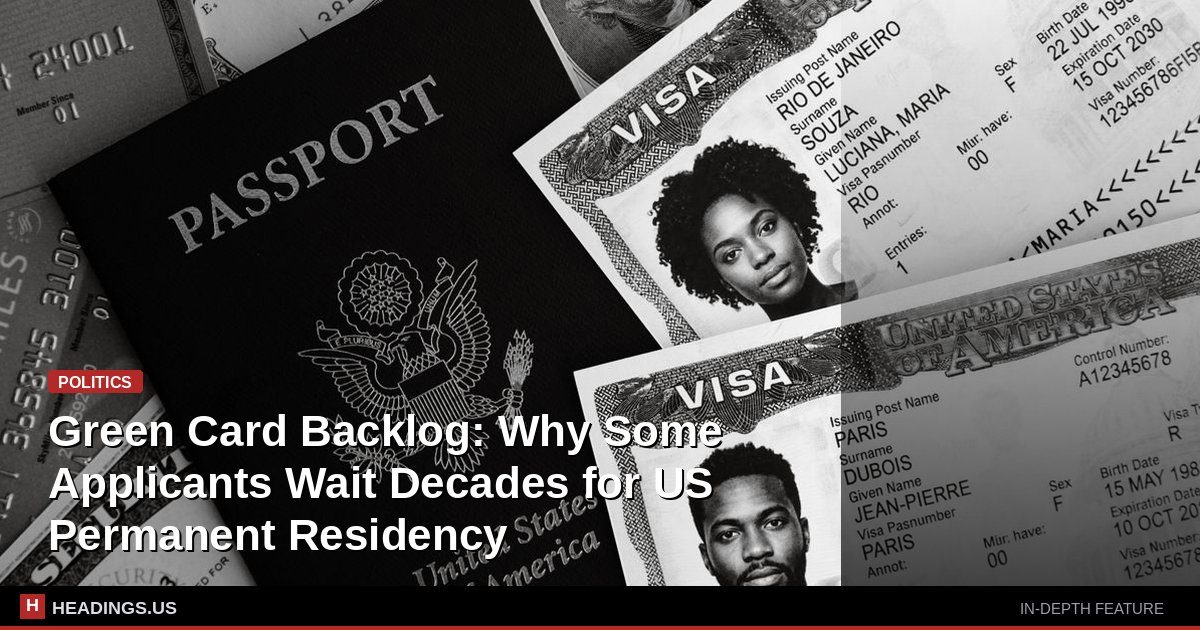
Maria filed her green card paperwork in 2012. She has a master's degree, a clean record, and an employer who sponsored her. She is still waiting. Her daughter, who arrived in the United States at age six, turned 21 before the family's priority date came up — and aged out of the process entirely.
Stories like Maria's are not unusual. They are the norm for hundreds of thousands of people caught in a green card backlog that now stretches decades for applicants from a handful of countries. The system is not broken in the sense that it stopped working. It is working exactly as designed — and the design caps how many people can get through each year.
The Numbers Behind the Wait
U.S. immigration law sets an annual ceiling of about 675,000 employment- and family-based green cards, plus per-country caps that limit any single country to roughly 7 percent of the total. That cap was written in 1965, when the global population was half what it is now and immigration patterns looked nothing like they do today.
The result is a queue that grows faster than it clears. According to the Cato Institute's analysis of State Department data, more than 1.2 million people are waiting in employment-based backlogs alone. Add family-sponsored categories and the number climbs past 4 million. For applicants from India and China, the two countries that dominate high-skilled visa petitions, the projected wait for some employment categories runs past 2050.
The State Department publishes a monthly Visa Bulletin that tells applicants which "priority dates" are current — essentially, whose turn it is. For years, the employment-based third preference category for Indian nationals has been stuck at dates from 2012 or earlier. That means someone who filed in 2013 could wait 40 years for a visa number that may never arrive.
The queue is not a line. It is a set of lines, sorted by country and category, and some of them barely move.
Why the Lines Move So Slowly
Three forces keep the backlog growing.
First, the per-country cap. No single country can receive more than 7 percent of the visas in any category. For India, which supplies the majority of H-1B skilled-worker petitions, that cap creates a bottleneck that no amount of employer sponsorship can fix. China hits the same wall in several categories.
Second, unused visas do not roll over the way most people assume. In family-based categories, visas that go unused in one year can be recaptured the next, but only within the same category. In employment-based categories, the rules are stricter, and thousands of numbers are lost annually because of administrative delays and processing gaps.
Third, demand keeps rising. The H-1B program admits 85,000 workers a year, and many of them eventually petition for green cards. Their spouses and children are counted against the same caps. The pipeline fills faster than the drain empties.
Who Waits the Longest
The backlog does not treat all applicants equally.
- Indian nationals in EB-2 and EB-3: The longest waits in the system. Projections from the Cato Institute put the wait for some Indian applicants at over 100 years in the worst-case category.
- Chinese nationals in EB-2 and EB-3: Waits of a decade or more, though shorter than India's.
- Filipino and Mexican family applicants: Sibling and adult-child categories have been backlogged since the 1990s. Some petitions filed in the 1990s are only now becoming current.
- Applicants from most other countries: Often current or near-current, which is why the backlog is invisible to many Americans.
There is also the aging-out problem. Children who are under 21 when a petition is filed can lose their place if they turn 21 before a visa becomes available. The Child Status Protection Act offers some relief, but it does not cover every case, and it does nothing for adult children in backlogged categories.
What the Backlog Costs
The human cost is obvious: careers stalled, families separated, workers unable to change jobs without risking their place in line. But the economic cost is measurable too.
A 2020 study from the National Foundation for American Policy found that every year of delay in the employment-based system costs the U.S. economy an estimated $1 billion in lost productivity and tax revenue. Workers trapped in the backlog often stay in jobs they would otherwise leave, which suppresses wages and mobility for everyone.
Employers feel it as well. Companies that sponsor workers watch them leave for Canada, Australia, or the United Kingdom, where skilled-worker visas move in months rather than decades. Canada's Express Entry system, for example, processes many applications in six months or less.
What Applicants Can Actually Do
There is no shortcut around the per-country cap. But there are practical steps that can improve an applicant's position.
1. Know your priority date and category
Your priority date is the day the government received your petition. Your category — EB-1, EB-2, EB-3, or a family preference — determines which line you are in. Check the monthly Visa Bulletin and compare your date to the "Final Action Date" for your category and country. If your date is earlier than the listed date, you are close.
2. Consider an EB-1 or EB-2 NIW petition
Extraordinary ability (EB-1A) and national interest waiver (EB-2 NIW) categories have shorter or no backlogs for many countries. They require stronger evidence of achievement, but they can move an applicant into a faster line. An immigration attorney can assess whether you qualify.
3. File adjustment of status when eligible
If you are in the U.S. and your priority date becomes current, filing for adjustment of status (Form I-485) can lock in your place and allow you to apply for work and travel documents. Timing matters — filing as soon as your date is current protects you from retrogression, when dates move backward.
4. Watch for retrogression
The Visa Bulletin sometimes moves backward when demand spikes. If your date was current and then retrogresses, you may lose the ability to file or finalize. Monitor the bulletin monthly and act quickly when your date appears.
5. Keep your petition alive
Family-based petitions can be revoked if the petitioner dies or if the applicant fails to respond to government notices. Keep your address updated with USCIS, respond to every request for evidence, and consider renewing your petition if it is close to expiring.
The Bigger Picture
Congress has not passed a major immigration overhaul since 1990. Bills to eliminate the per-country cap have passed the House twice in recent years but stalled in the Senate. Until the caps change, the math will not change: more people will enter the queue each year than leave it.
For applicants, that means planning for a wait measured in years, not months. For Americans, it means understanding that the person behind them in line at the grocery store may be a doctor, an engineer, or a caregiver who has been waiting a decade for permission to stay.
Maria, the applicant who filed in 2012, still checks the Visa Bulletin every month. Her daughter is now 24 and living in India, waiting for a petition that may not become current for another decade. "I did everything right," she said. "The system just wasn't built for me."