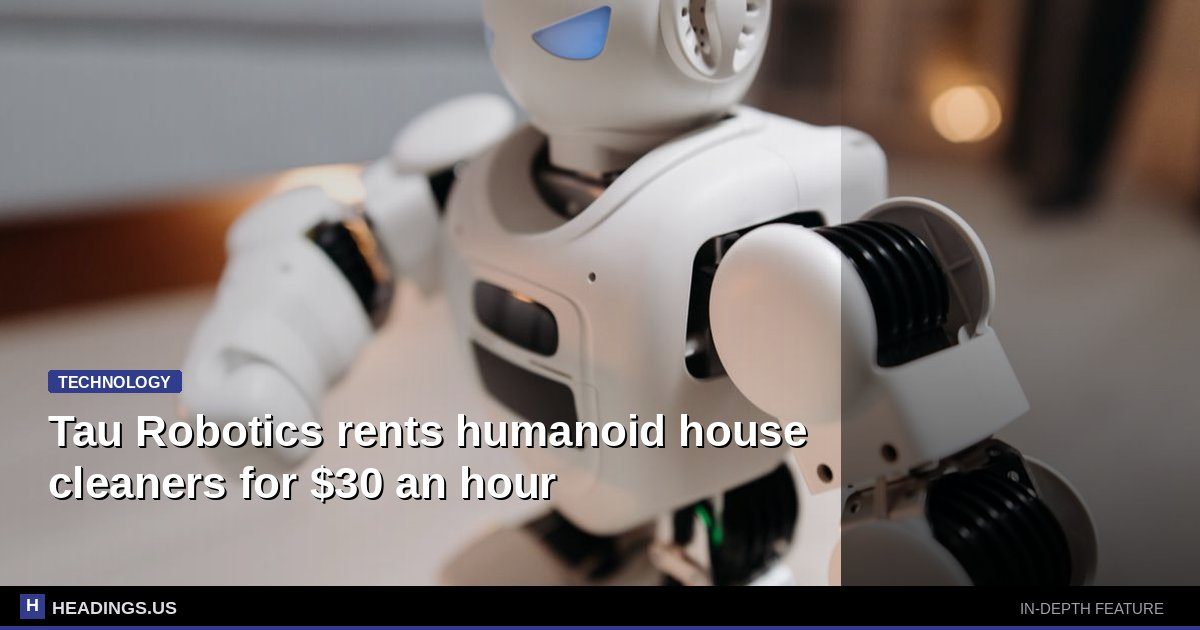
Tau Robotics is renting humanoid robots to clean homes at $30 an hour, with human operators controlling every movement remotely.
The company's co-founder, Cornelia Weinzierl, told the BBC the robots can handle a range of household chores. "They can wipe your surfaces, it can do your laundry, it can make your beds," she said.
The robots are not autonomous. A human pilot directs each one from off-site, meaning customers are paying for a remote worker operating a machine rather than artificial intelligence that cleans on its own.
Finn Metz, a resident of San Francisco, booked a session to test whether the service lives up to its promise. The BBC filmed the demonstration for a video report produced by Katy Bailes and edited by Meiying Wu.
The $30 hourly rate puts Tau's service in the same range as professional human house cleaners in many U.S. cities, where rates typically run between $25 and $50 an hour. That raises a straightforward question for consumers: why hire a robot if a person costs about the same?
Weinzierl's answer is capability and consistency. The robot can be directed to perform multiple tasks in a single session, from laundry to bed-making to surface wiping, without the scheduling constraints of a human worker.
But the remote-control model carries its own limits. A human operator can only run one robot at a time, which caps how many homes Tau can serve and keeps labor costs built into the business. The company has not said how many robots it operates or how many customers it has served.
Tau Robotics is part of a broader push by startups to bring humanoid machines into homes and workplaces. Most companies in the space, including Tesla and Figure, are working toward fully autonomous robots that can operate without human pilots. Tau's approach sidesteps that technical challenge by keeping a person in the loop.
The tradeoff is scalability. Autonomous robots could eventually run around the clock at near-zero marginal cost per hour. Remote-controlled robots cannot.
For now, the service is available in San Francisco, where Metz booked his session. The BBC did not report his verdict in the story details provided.
Whether customers will pay human-equivalent rates for a machine that still needs a human behind it is the central test for Tau's model. The company is betting that the novelty and flexibility of a robot that can do multiple chores will outweigh the cost comparison.