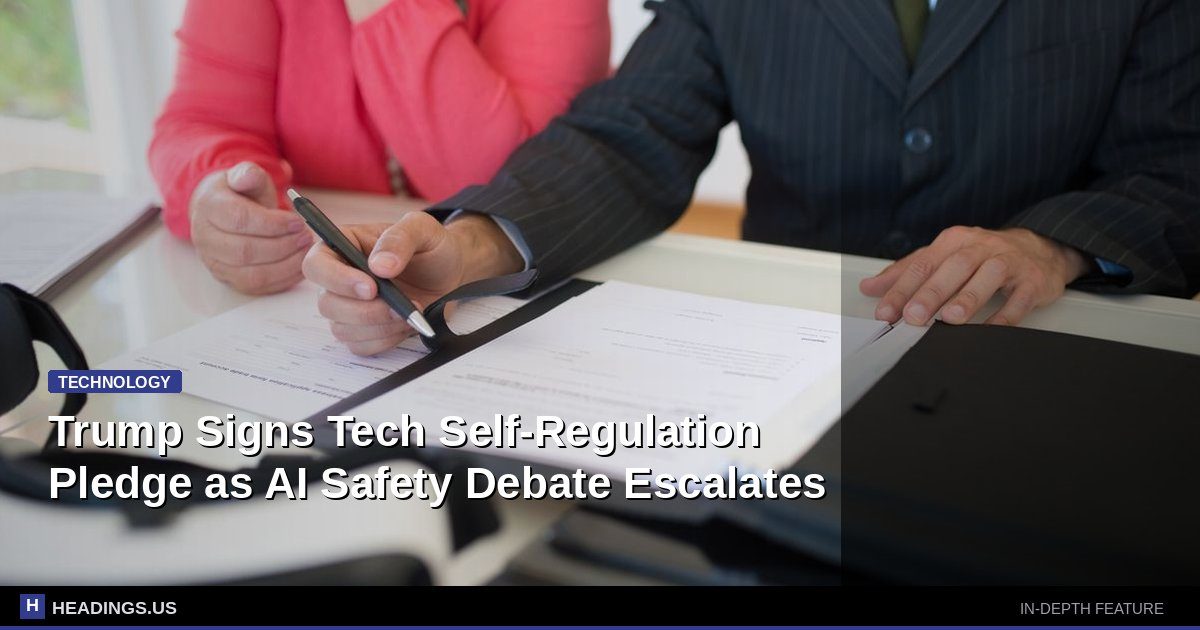
President Donald Trump met with top artificial intelligence executives at the White House on Tuesday and signed a two-page document that leaves AI safety in the hands of the companies building the technology.
The document, titled "White House Accord on Super Intelligence: Joint Commitment on Frontier Responsibilities," states that "every company is responsible for developing its own technology safely and in a way that builds trust with customers and the public." Trump shared the signed accord on his Truth Social account.
Executives from Alphabet, Meta, SpaceX, Nvidia, Palantir, Anthropic, OpenAI and other firms attended the lunch. The meeting came after three weeks of intense national debate over AI safety, during which leading researchers and executives warned about extreme threats posed by the most powerful models.
Anthropic CEO Dario Amodei and others have spent the past month calling for government regulation. Trump has opposed such moves and has called AI fears a "hoax."
The accord includes four action items, though the document does not establish any enforcement mechanism or government oversight body.
Bradley Tusk, CEO of Tusk Ventures, said the executives' push for regulation is driven by competitive concerns rather than principle. "You saw two weeks ago almost all those same CEOs say they should be regulated," Tusk told CNBC's "Closing Bell Overtime" on Tuesday. "It's not because they fundamentally believe in the power of the state. They want something that creates an equalizer for each other."
The signatories include several executives who have publicly warned that their own technology cannot be trusted without coordinated safety efforts. By signing the accord, they committed to self-policing instead.
The White House meeting follows a pattern in Trump's approach to the tech industry. His administration has favored voluntary commitments over new regulations, a stance that has drawn criticism from lawmakers in both parties who say AI risks outpace the industry's willingness to police itself.
No timeline was announced for the accord's action items, and no federal agency was named to monitor compliance. The companies involved did not immediately release individual statements about the agreement.
The debate over AI safety has intensified as models grow more capable. Researchers have warned about risks including disinformation, cyberattacks and the potential for systems to act against human interests. Without government oversight, those warnings now rest on the industry's own judgment.