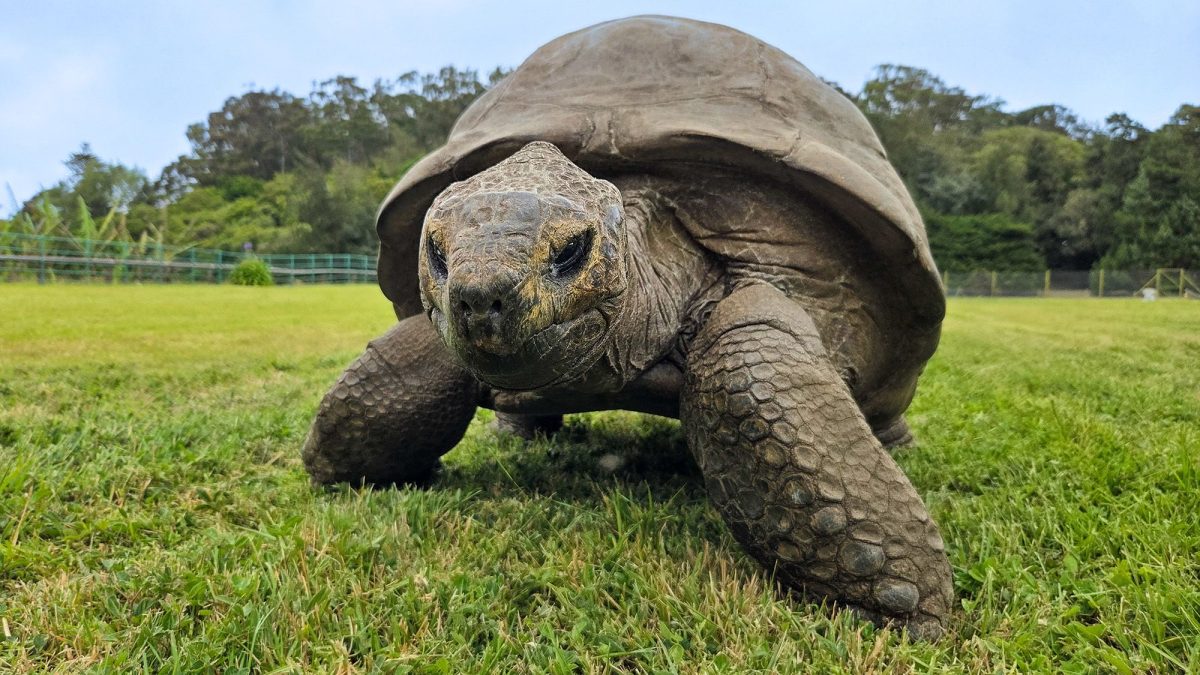
Jonathan, a Seychelles giant tortoise that has lived on the South Atlantic island of Saint Helena since the 1880s, has reached an estimated 194 years old — making him the oldest known living land animal on Earth. Scientists studying tortoise biology say they now have a clearer picture of why his species can survive for nearly two centuries while most mammals, including humans, age out in a fraction of that time.
The answer lies in how tortoises handle the cellular damage that accumulates with age. Unlike mammals, tortoises show remarkably slow rates of aging across most of their lifespan, with mortality risk rising only slightly as they get older rather than climbing steeply the way it does in humans after middle age. Researchers describe this pattern as negligible senescence — the near-absence of the physical decline that defines old age in most species.
Jonathan arrived on Saint Helena, a British overseas territory about 1,200 miles west of Angola, in 1882 as a gift to the island's governor. He was already fully grown at the time, which is why his hatch date is placed around 1832. He has outlived every human born on the island during his residency and has been featured on Saint Helena's five-pence coin.
Tortoise longevity is tied to several biological traits that researchers have documented across species. Their slow metabolism, armored shells that deter predators, and low annual reproductive output all push their life expectancy upward. Cells taken from long-lived tortoise species also divide more slowly in laboratory conditions and resist certain forms of oxidative stress better than cells from shorter-lived animals.
Jonathan is now blind from cataracts and has lost his sense of smell, but he retains his hearing and continues to graze on the lawn of Plantation House, the governor's residence, alongside three other giant tortoises. His caretakers feed him by hand once a week to ensure he gets enough calories and nutrients.
His species, the Seychelles giant tortoise, was once hunted nearly to extinction by sailors who stocked their ships with the animals as a source of fresh meat during long voyages. Fewer than 100,000 giant tortoises remain across the Indian Ocean and Galapagos Islands today, according to conservation estimates.
Jonathan's record is not the ceiling for his kind. A radiated tortoise named Tu'i Malila, kept by the Tongan royal family, was believed to be at least 188 years old when she died in 1965. Another giant tortoise, Adwaita, died in a Kolkata zoo in 2006 at an estimated age of 255, though that figure has been disputed.