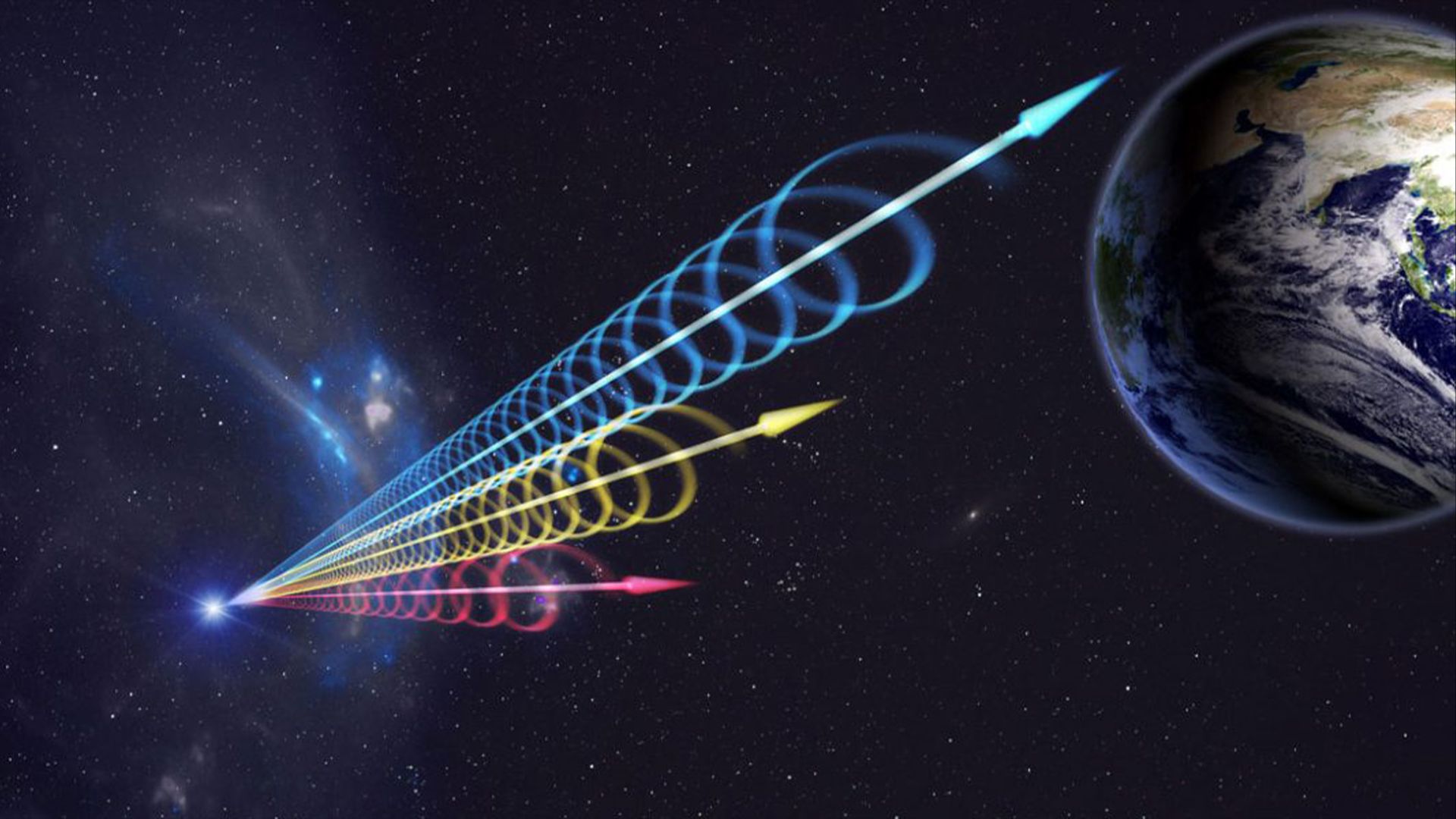
Astronomers using the James Webb Space Telescope have pinpointed a fast radio burst roughly 8 billion light-years from Earth, the most distant such signal ever detected, according to research published in the journal Science. The burst, designated FRB 20220610A, released in a few milliseconds the same amount of energy the Sun emits over 30 years.
The detection matters because fast radio bursts can be used to weigh the universe. As the radio waves travel across billions of light-years, they pass through clouds of ionized gas. By measuring how much the signal smears out along the way, astronomers can calculate how much ordinary matter sits between Earth and the burst's origin — matter that has otherwise been nearly impossible to find.
Roughly 70 percent of the normal matter in the universe is unaccounted for, according to models of the Big Bang. Astronomers call this the "missing baryon" problem. Fast radio bursts offer a way to locate it, because the smearing effect scales with distance. The farther the burst, the more gas it crosses, and the more precise the measurement of that gas becomes.
The burst was first picked up by the Australian Square Kilometre Array Pathfinder in June 2022, then traced to a compact group of two or three merging galaxies using the Very Large Telescope in Chile. Webb's infrared instruments then confirmed the distance, placing the signal in a galaxy that existed when the universe was about 6 billion years old — less than half its current age.
"This is the first time we've been able to use a fast radio burst to probe the structure of the universe at such a distance," said Stuart Ryder, an astronomer at Macquarie University in Australia and lead author of the study. "We now have a new way to measure the missing matter between galaxies."
Only about 50 fast radio bursts have been traced back to their host galaxies since the signals were first discovered in 2007. Most originate from magnetars — highly magnetized neutron stars left behind when massive stars collapse. The bursts last milliseconds but can briefly outshine entire galaxies in radio wavelengths.
The team estimates that current radio telescopes can detect fast radio bursts out to about 8 billion light-years, but future instruments like the Square Kilometre Array, now under construction in Australia and South Africa, should push that range further. That would let astronomers map the distribution of matter across a larger share of the observable universe than any existing method allows.
FRB 20220610A was detected in a galaxy group that appears to be in the process of merging, a chaotic environment that may help explain what produces these signals. Astronomers have found that a small fraction of fast radio bursts repeat, but the majority, including this one, appear to fire only once.