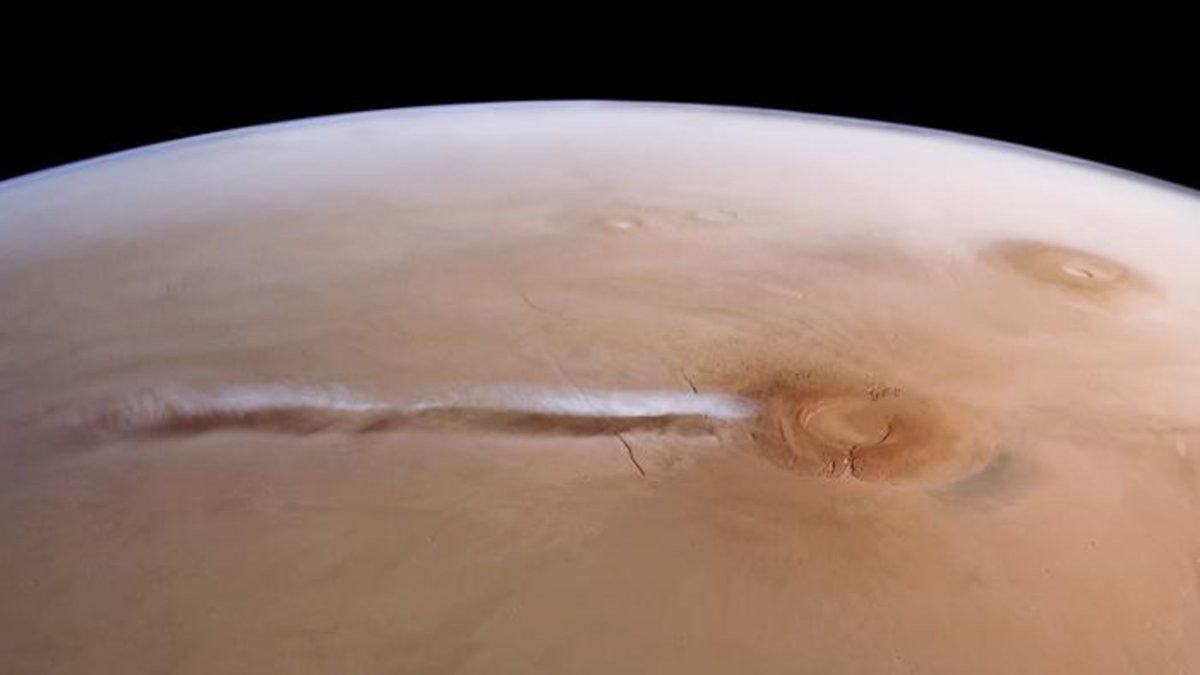
A cloud stretching roughly 1,000 miles forms above Mars every single day and disappears within hours, following rules of motion that atmospheric scientists say do not apply to any weather system on Earth. The cloud, first catalogued in images from the European Space Agency's Mars Express orbiter, reappears on a daily cycle near the planet's equator and has no known terrestrial equivalent.
The structure is a water-ice cloud, not dust, and it assembles along the flanks of Arsia Mons, one of the largest volcanoes on Mars at more than 12 miles high. It grows to its full 1,000-mile length within about two and a half hours after local sunrise, then thins and vanishes by the Martian afternoon. The pattern repeats with such regularity that researchers nicknamed it the Arsia Mons Elongated Cloud, or AMEC.
What makes the cloud unusual is its speed. Its leading edge races westward at roughly 600 kilometers per hour, driven by a mechanism that planetary scientists describe as exotic compared with Earth's meteorology. On Earth, mountain clouds form when moist air is forced upward over a peak and cools. The Martian cloud instead appears tied to the volcano's western slope and the extreme day-night temperature swings of the thin Martian atmosphere, which is about 1 percent as dense as Earth's.
Jorge Hernández-Bernal, a researcher at the University of the Basque Country who led the most detailed study of the cloud, said the formation's daily rhythm was "a very specific phenomenon" tied to the volcano's shape and the planet's rotation. His team analyzed thousands of Mars Express and Mars Reconnaissance Orbiter images to confirm the cycle holds through most of the Martian year.
The cloud's scale is difficult to overstate. At 1,000 miles long, it would stretch from Chicago to Los Angeles with room to spare, or span nearly half the distance across the continental United States. Its width is roughly 90 miles, and its altitude sits between 20 and 25 miles above the surface, well above the dust layers that obscure much of Mars.
Studying AMEC matters beyond curiosity about a single cloud. Water-ice clouds on Mars trace how water vapor moves through the planet's atmosphere, and that movement is central to the question of how much water Mars lost to space over billions of years. The cloud also poses a practical problem for spacecraft: its daily formation creates a recurring patch of thin atmosphere that engineers must account for when planning aerobraking maneuvers and descent trajectories.
The cloud is invisible to most ground-based telescopes because it forms and dissipates within the Martian morning, when Mars is often too faint or too low in the sky for amateur observers. Spacecraft in Martian orbit captured it reliably only after researchers knew when and where to look.