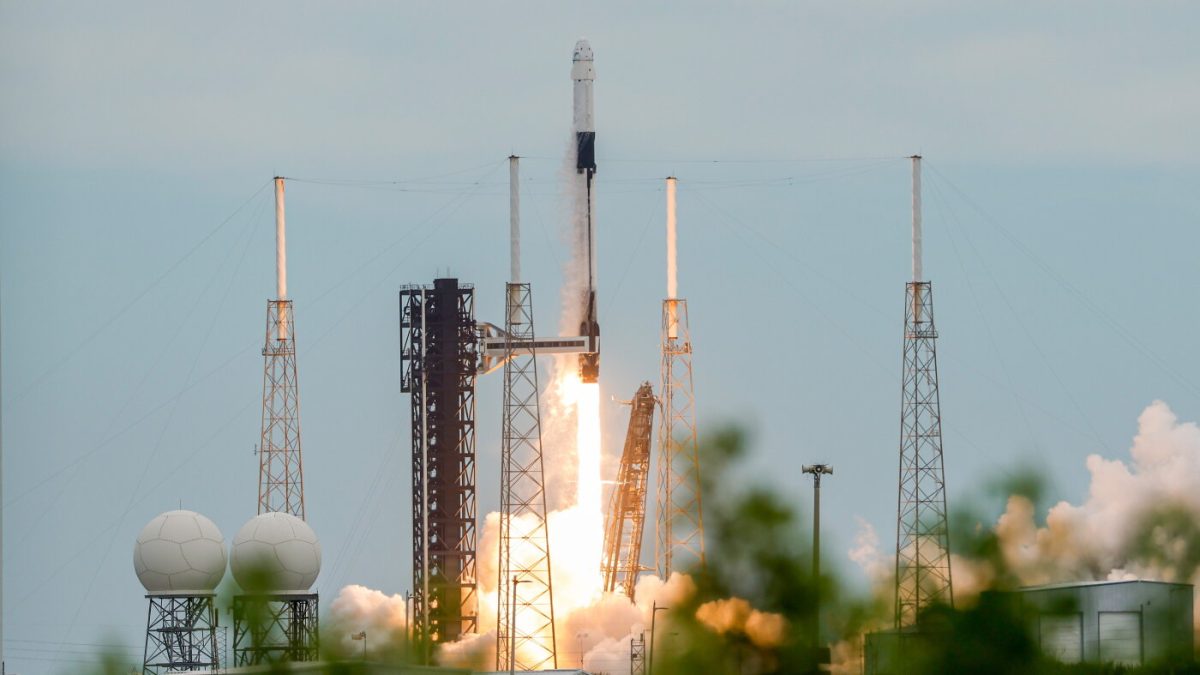
A SpaceX Falcon 9 rocket lifted off from NASA's Kennedy Space Center in Florida carrying four astronauts aboard a Crew Dragon capsule, sending the crew on a six-month rotation to the International Space Station.
The capsule, named for the mission under NASA's Commercial Crew Program, separated from the rocket's second stage roughly 12 minutes after launch and began a series of thruster burns to close the distance to the station. Docking is expected about 28 hours after liftoff, with the hatch opening shortly afterward.
The four-person crew joins the Expedition team already aboard the orbiting laboratory, temporarily raising the station's population to seven. The arriving astronauts will spend roughly six months conducting experiments in biology, materials science and Earth observation before returning in the same capsule.
SpaceX flies the Crew Dragon under a contract with NASA worth billions of dollars, part of an effort the agency began after the space shuttle retired in 2011. For nearly a decade afterward, the United States paid Russia for seats on Soyuz spacecraft to reach the station — a dependency the Commercial Crew Program was designed to end. SpaceX flew its first crewed test flight in 2020 and has since become the primary vehicle for American astronaut transport.
The Falcon 9's first stage returned to a landing zone near the Florida coast minutes after separation, part of SpaceX's practice of recovering and reusing boosters to cut launch costs. The company has landed boosters more than 300 times, and individual first stages have flown as many as two dozen missions.
The International Space Station has been continuously occupied since November 2000 and orbits roughly 250 miles above Earth at about 17,500 mph, circling the planet every 90 minutes. NASA and its partners — Russia, Europe, Japan and Canada — plan to operate the station through at least 2030, after which commercial stations are expected to take over low-Earth orbit research.
Weather at the Cape cooperated for the launch window, with forecasters earlier in the week pegging the probability of favorable conditions above 90 percent. Mission control in Hawthorne, California, confirmed the capsule's solar arrays deployed on schedule and the crew was in good health as it settled into orbit.