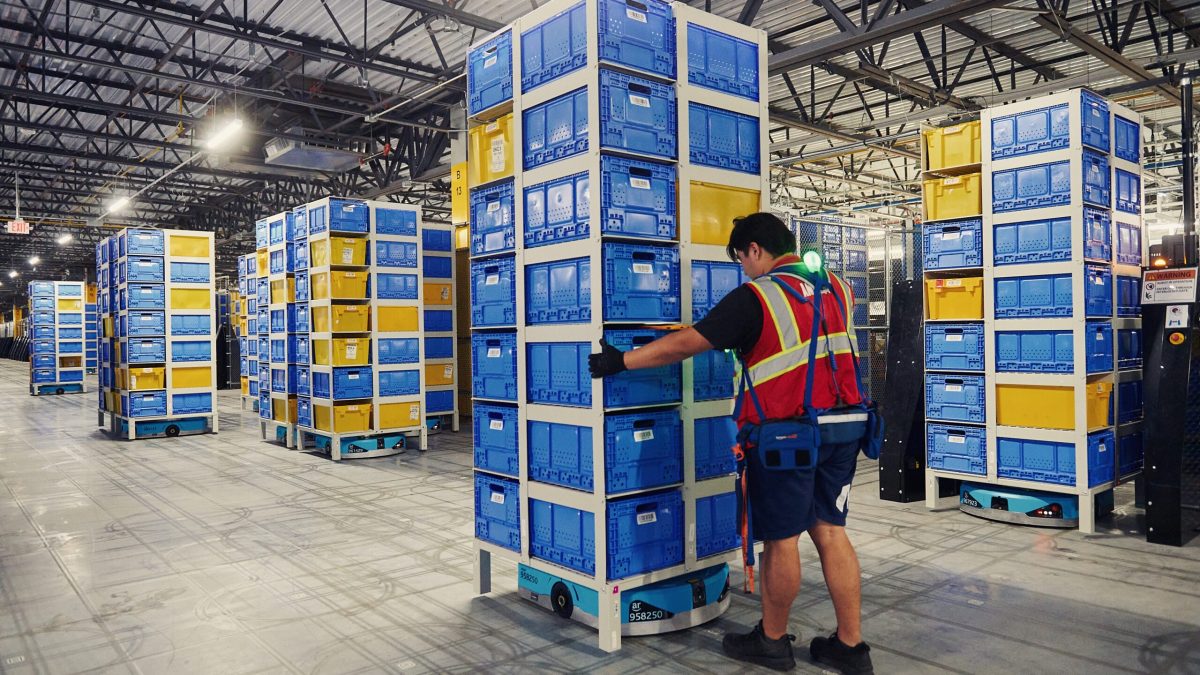
Amazon has surpassed 1 million robots operating across its global fulfillment network, the company confirmed, marking a milestone that places automated machines alongside a human warehouse workforce that numbers roughly 1.5 million employees worldwide.
The scale of the deployment makes Amazon the world's largest operator of industrial robots. The company has added robots at a pace that outpaces its hiring in recent years, with some fulfillment centers now running thousands of machines per facility handling picking, packing, and sorting tasks once performed entirely by people.
The shift carries direct consequences for the roughly 2 million Americans employed in the warehousing sector, a workforce characterized by high turnover, physical strain, and injury rates that exceed the national average for private industry, according to Bureau of Labor Statistics data.
Newer collaborative robots, designed to work in close physical proximity to humans rather than behind safety cages, represent a departure from the older generation of fully segregated automated systems. That proximity changes the safety calculus for workers on the floor.
"The rise of collaborative robots really changes that dynamic for two reasons: one is that it is physically proximate," one researcher noted, pointing to the way machines and humans now share the same workspace rather than operating in separate zones.
Amazon has framed its automation push as a way to eliminate what it describes as "dull, dirty and dangerous" tasks — language the company and outside observers have used to characterize repetitive lifting, sorting, and packing work that contributes to musculoskeletal injuries among warehouse staff.
Company officials have said robots are designed to augment human workers, not replace them, and that automation has coincided with continued hiring. Amazon employed roughly 1.5 million people globally as of its most recent annual filing, making it one of the largest private employers in the United States.
The warehousing sector's labor dynamics complicate that narrative. Turnover in the industry regularly exceeds 40% annually, and Amazon has faced regulatory scrutiny and worker complaints over injury rates at facilities where robots and humans work in tandem.
Labor economists tracking the sector note that collaborative robots lower the barrier to automating tasks that previously required human dexterity and judgment, potentially accelerating displacement in roles that were once considered resistant to automation.
The Teamsters union, which has been organizing Amazon warehouse workers since 2021, has cited automation as a central concern in contract negotiations, arguing that workers deserve advance notice and retraining guarantees when robots are introduced at their facilities.
Amazon has not disclosed how many human jobs have been eliminated at facilities where robot deployments have expanded, and the company does not break out warehouse-specific employment figures in its public filings.
The company's robotics division, Amazon Robotics, grew out of its 2012 acquisition of Kiva Systems for $775 million. That purchase gave Amazon control of the mobile shelving robots that now form the backbone of its automated fulfillment centers.