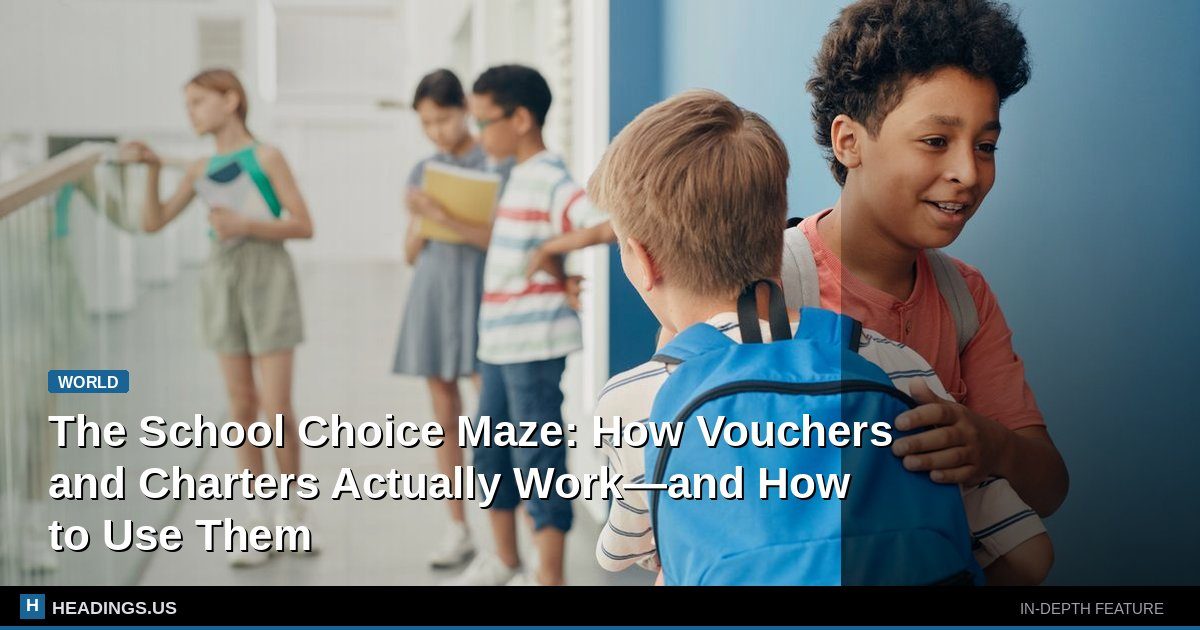
When Marisol Vega moved from Chicago to Phoenix, she assumed her son would attend the neighborhood school three blocks away. Instead, she found herself filling out an application for a state program that would hand her roughly $7,000 a year to spend on private tuition, tutoring, or homeschool curriculum. She had never heard of an education savings account. Within a month, she had three of them open across two states.
Vega's confusion is common. The United States now runs one of the most complicated school choice systems on earth, a patchwork of vouchers, tax-credit scholarships, education savings accounts, charter schools, magnet programs, and open-enrollment policies. More than 1 million students use some form of private school choice, according to EdChoice, a nonprofit that tracks the programs. Another 3.7 million attend charter schools, per the National Alliance for Public Charter Schools.
That's a lot of families navigating a lot of fine print. Here's what the rules actually say.
Vouchers vs. ESAs: Similar Names, Different Machines
A traditional voucher works like a coupon. The state takes a portion of the per-pupil funding it would have sent to your local public school and redirects it to a private school of your choice. The money never touches your bank account. Roughly 30 states and the District of Columbia operate some version of this, though the details vary enough that comparing two states is like comparing two different countries.
Education savings accounts, or ESAs, work differently. The state deposits funds into an account you control, and you decide how to spend it. Most ESA programs allow private school tuition, but many also cover tutoring, online courses, therapy, textbooks, and even homeschool supplies. Arizona's Empowerment Scholarship Account program, the oldest and largest in the country, serves over 70,000 students and lets families spend funds on everything from piano lessons to speech therapy, as long as it's tied to education.
Tax-credit scholarship programs are a third model. Instead of the state writing a check, businesses or individuals donate to a scholarship-granting organization and receive a tax credit in return. Florida's program, the largest of its kind, serves more than 100,000 students. The practical effect for parents is similar, but the funding stream is different, which matters when you're trying to figure out who to call when something goes wrong.
Charter Schools: Public Money, Private Management
Charter schools are publicly funded but independently run. They operate under a contract, or charter, with a state or local authorizing body. If they miss performance targets, the charter can be revoked. If they succeed, they can expand.
About 7,800 charter schools operate nationwide, enrolling roughly 3.7 million students, according to the National Alliance for Public Charter Schools. That's about 7 percent of all public school students. In cities like New Orleans, Detroit, and Washington, D.C., charters enroll a far higher share—in New Orleans, more than 75 percent of public school students attend charters.
Charters cannot charge tuition. If they're oversubscribed, they must use a lottery. They also cannot selectively admit students based on test scores, though some critics argue that application requirements and location effectively screen out the neediest families. That debate is ongoing and unresolved.
What charter schools can do is specialize. Some focus on STEM. Some use a classical curriculum. Some serve specific populations, such as students with autism or English language learners. That specialization is the appeal for many parents.
What the Research Actually Shows
The evidence on school choice is mixed, and anyone who tells you otherwise is selling something.
A 2019 study from the National Center for Education Statistics found that charter school students in urban areas outperformed their traditional public school peers in reading and math, but the gains were modest and inconsistent across cities. A 2022 study from the University of California, Berkeley, found that voucher programs in Louisiana and Indiana produced significant declines in student achievement for participants, particularly in math.
Meanwhile, a 2023 analysis from the Brookings Institution found that the effects of vouchers depend heavily on program design. Programs with strict accountability requirements and caps on eligibility tend to produce better outcomes than universal programs with few guardrails.
The short version: choice can work. It doesn't always. The difference often comes down to how the program is built and whether the schools receiving public money are held to any standard.
How to Actually Use These Programs
If you're considering a choice option, start with your state education agency's website. Every state that operates a voucher or ESA program publishes eligibility rules, application deadlines, and spending categories. Read them before you assume you qualify.
Next, verify the school. Private schools that accept vouchers are not always accredited. In some states, they face almost no oversight. Ask for graduation rates, test scores, and teacher turnover data. If a school won't provide them, that's an answer.
For charter schools, check the charter authorizer. That's the entity that holds the school accountable. A charter authorized by a strong state board is a different proposition than one authorized by a local district with limited capacity to monitor it. The National Association of Charter School Authorizers maintains a list of quality authorizers by state.
Finally, understand the money. In most voucher and ESA programs, the state pays less per student than it would have spent on that student in public school. That means the private school either charges tuition above the voucher amount, raises outside funds, or cuts costs. Ask which one applies. It affects your child's experience.