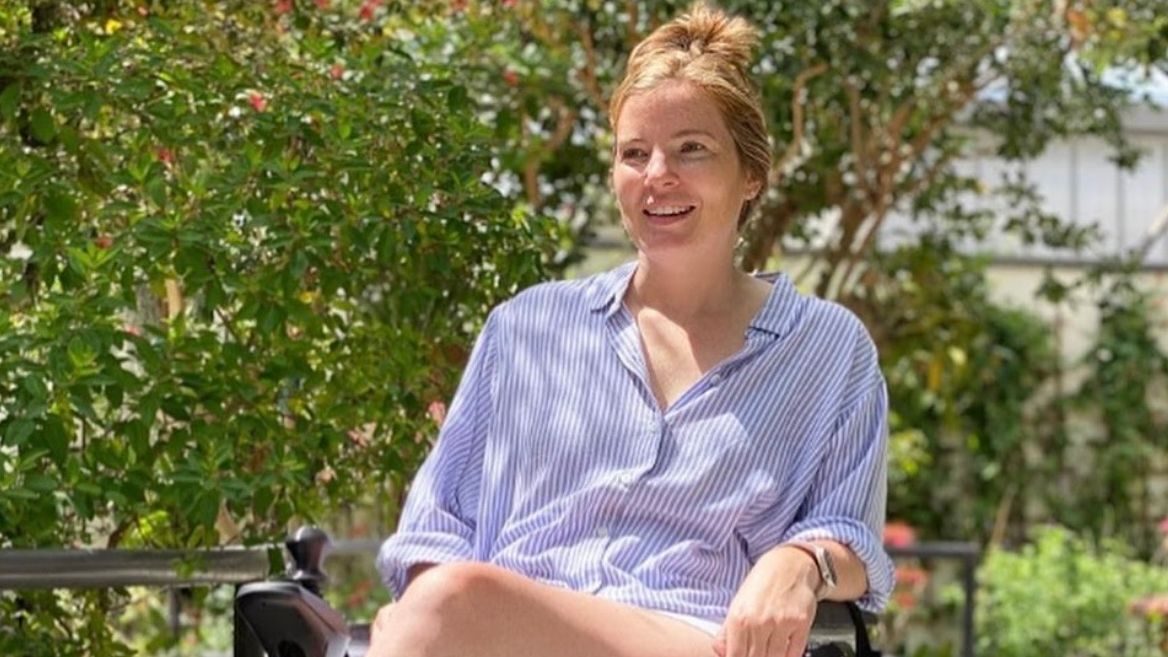
Brooke Eby, a former tech sales executive diagnosed with ALS in 2019, spent the final years of her life documenting her physical decline on social media to accelerate research funding and drug development for the fatal neurodegenerative disease. Eby died from complications of ALS, the disease she had chronicled to millions of followers.
Her path to diagnosis followed a pattern common to ALS patients: a slight limp that appeared without explanation, followed by years of medical appointments before doctors identified the cause. Amyotrophic lateral sclerosis, which affects roughly 5,000 new patients in the United States each year, has no cure and typically kills within two to five years of symptom onset.
Eby built an audience by refusing the standard script for terminal illness. She posted videos about dating with a feeding tube, rated her mobility equipment like fashion accessories, and labeled one recurring segment "Almost Haute Couture." Her following grew into one of the largest platforms dedicated to ALS awareness.
She directed much of that attention at the FDA's drug approval process. When the agency granted approval to Relyvrio, an ALS treatment whose effectiveness remained disputed, Eby documented her own experience taking it under the heading "Relyvrio Challenge." She was direct about the stakes: patients did not have time to wait for perfect data.
Her sharpest critique targeted the economics of disease research. "If a Kardashian got ALS, we would all be saved," she wrote. "The Kardashian Curse would be turned into the Kardashian Cure." The line, shared widely, captured her argument that ALS research lags because the disease lacks famous advocates and the funding attention that follows them.
ALS, also known as Lou Gehrig's disease, progressively destroys the nerve cells controlling voluntary muscle movement. Patients lose the ability to walk, speak, swallow, and eventually breathe. The Centers for Disease Control and Prevention estimates that 30,000 Americans are living with the condition at any given time.
Eby's approach differed from traditional patient advocacy, which often centers on congressional testimony and fundraising galas. She instead made her own body the evidence, recording each stage of loss as it happened. The strategy drew attention from media outlets and connected her with researchers and other patients who used her videos to understand what was coming.
Her death adds her name to a list of patients who spent their final years pressing for treatments they would not live to receive. The FDA has approved only a handful of ALS drugs, most of which extend life by months rather than years, and none of which halt the disease's progression.