The Canadian Hydrogen Intensity Mapping Experiment has demonstrated a new technique for measuring how fast the universe is expanding, using radio signals from hydrogen gas in far-off galaxies to chart cosmic distances. The method, reported by the collaboration behind the CHIME telescope in British Columbia's Okanagan Valley, gives astrophysicists a third independent tool for resolving a stubborn disagreement over the universe's expansion rate.
The disagreement, known as the Hubble tension, pits measurements of the expansion rate — called the Hubble constant — derived from the cosmic microwave background against those taken from nearby supernovae and variable stars. The two approaches disagree by roughly 8%, a gap that has widened as instruments have improved over the past decade. If the discrepancy is real and not a measurement error, it would require revising the standard model of cosmology.
CHIME's approach relies on detecting 21-centimeter radio waves emitted by neutral hydrogen, the most abundant element in the universe. By mapping how that emission is stretched by cosmic expansion across a wide swath of sky, the telescope can estimate distances to vast regions of space without relying on the supernovae or stellar yardsticks that anchor existing measurements. The technique is known as intensity mapping.
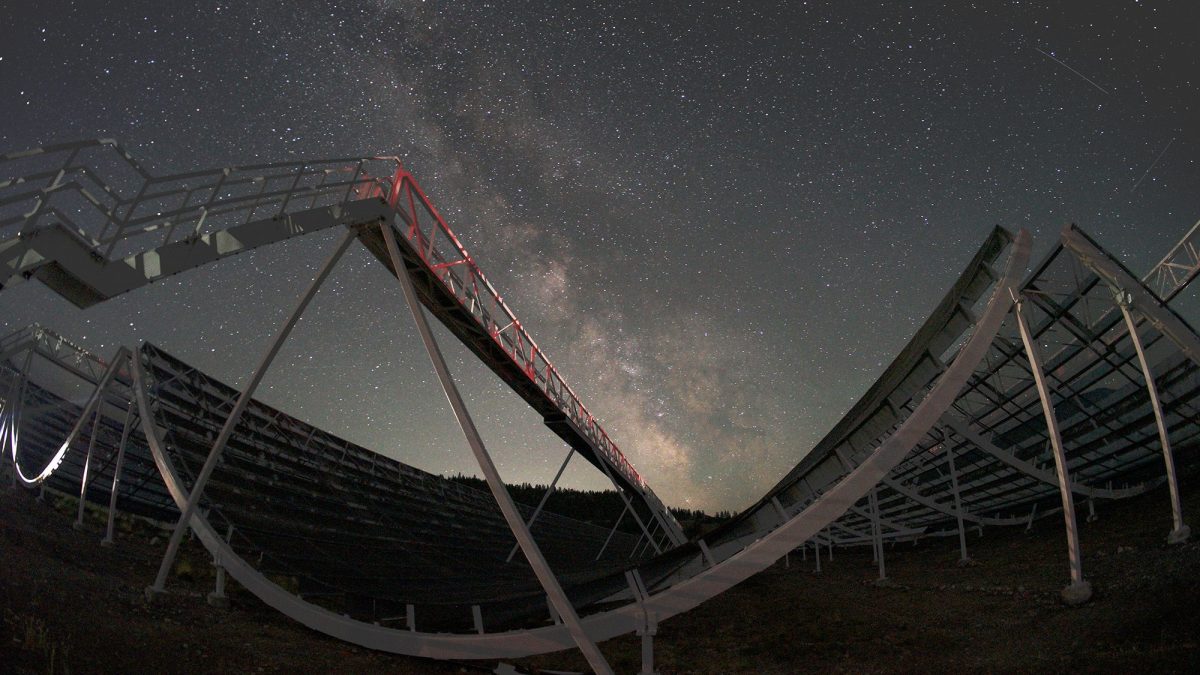
The telescope, which began operating in 2017 at the Dominion Radio Astrophysical Observatory, was originally built to detect fast radio bursts and has since logged more than 1,000 of them. Its fixed, half-pipe design of four 100-meter cylinders and more than 1,000 antennas has no moving parts, letting it scan the entire northern sky each day.
Researchers involved in the project said the early results are consistent with expansion rates measured from the cosmic microwave background, the afterglow of the Big Bang. That agreement, if it holds as the survey collects more data, would point toward problems in the supernovae-based measurements rather than in the underlying cosmological model.
The CHIME collaboration plans to expand its survey over the coming years, building a larger catalog of hydrogen signals that should tighten the error bars on its expansion estimate. A second telescope, CHIME/FRB Outriggers, is under development to sharpen the localization of fast radio bursts and improve the precision of the distance measurements.
Independent confirmation of the expansion rate matters beyond cosmology textbooks. The Hubble constant sets the age of the universe, the size of the observable cosmos, and the behavior of dark energy — the mysterious force thought to be accelerating expansion. A firm number determines whether that acceleration is constant or changing over time.