The last time an American stood on the Moon, gas cost 36 cents a gallon, a new Mustang sold for about $3,000, and Richard Nixon was in the White House. Apollo 17 astronaut Gene Cernan climbed back into the lunar module on December 14, 1972, and no human has set foot on another world since.
That half-century gap is about to close. NASA's Artemis program is building the rockets, spacecraft, landers, and ground systems to send astronauts back to the Moon — this time to stay longer, explore more, and bring home science that could reshape what we know about Earth's nearest neighbor and our own planet.
The program is not a rerun of Apollo. It is bigger, slower, more international, and far more commercial. It also has a real chance of slipping again, which is why understanding how it works matters more than memorizing any single launch date.
What Is the Artemis Program and Why Is NASA Going Back?
Artemis is NASA's human deep-space exploration effort, named for the twin sister of Apollo in Greek mythology. Its stated goal is to land the first woman and the first person of color on the Moon, establish a sustained presence in lunar orbit and on the surface, and use the Moon as a proving ground for eventual crewed missions to Mars.
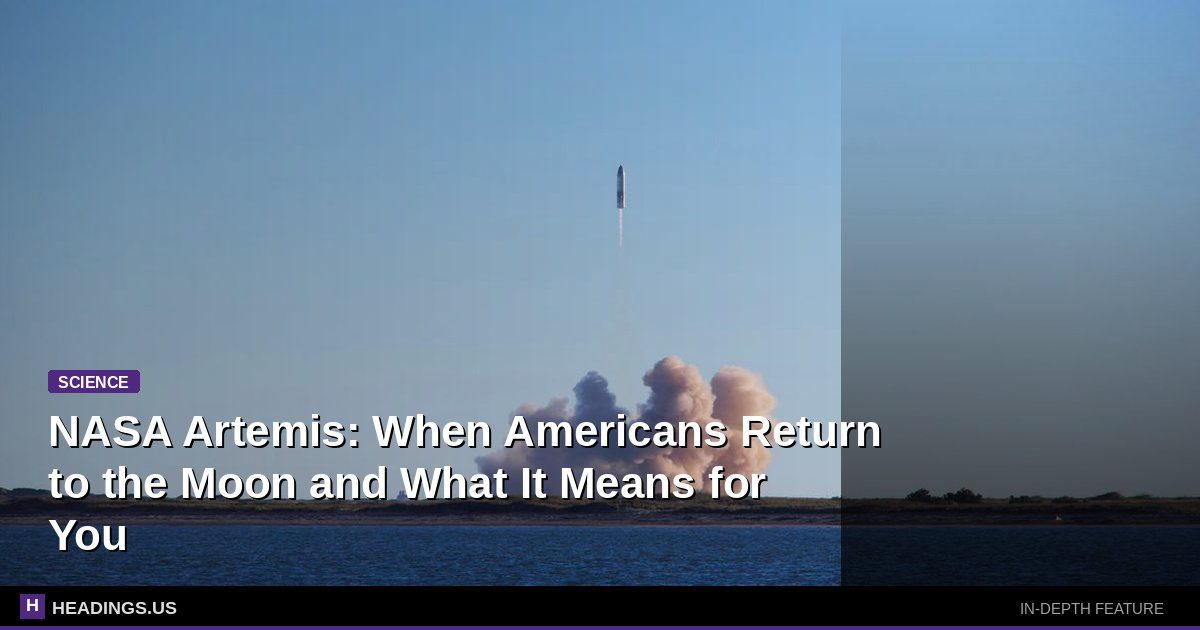
The hardware stack has three main pieces. The Space Launch System, or SLS, is a 322-foot rocket that produces 8.8 million pounds of thrust at liftoff — about 15 percent more than the Saturn V that carried Apollo astronauts. The Orion capsule sits on top and carries up to four crew members. The Human Landing System, built by SpaceX using a variant of its Starship vehicle, will ferry astronauts between lunar orbit and the surface.
Artemis I flew uncrewed in late 2022, sending Orion around the Moon and back on a 1.4-million-mile journey. The capsule splashed down in the Pacific after 25.5 days, and its heat shield endured reentry temperatures near 5,000 degrees Fahrenheit. That mission validated the rocket and capsule but also revealed charring on the heat shield that engineers spent months investigating.
Artemis II is the crewed flight test — four astronauts on a free-return trajectory around the Moon, no landing. Artemis III is the landing mission. NASA has said it is targeting a crewed lunar landing in the mid-2020s, though independent watchdogs and NASA's own leadership have acknowledged the schedule depends on Starship readiness, spacesuit delivery, and Orion's life-support systems.
The Real Cost of Returning to the Moon
NASA's Office of Inspector General has estimated the Artemis program will cost roughly $93 billion through 2025, with each SLS launch running about $4.1 billion. That per-launch figure is one reason the program draws scrutiny from lawmakers on both sides.
For context, the entire Apollo program cost about $25.8 billion in 1960s dollars, which converts to roughly $257 billion today. Artemis is spending more slowly and spreading work across more contractors and more states — a political feature, not a bug. SLS components are built in Louisiana, Alabama, Utah, and Florida, and every one of those states has senators who vote on NASA's budget.
The commercial side changes the math. NASA is paying SpaceX a fixed price for lunar landings rather than owning the hardware. That shifts cost risk to the company. It also means NASA does not control the schedule the way it did in the Apollo era.
NASA has spent more than a decade and tens of billions of dollars developing SLS and Orion, and the agency still cannot say with certainty when the first crewed landing will occur. — U.S. Government Accountability Office, assessments of Artemis
Taxpayers fund this. NASA's annual budget has hovered around $25 billion in recent years, roughly 0.4 percent of federal spending. For every dollar Americans pay in federal taxes, less than half a cent goes to NASA. That is a fraction of what the agency received at the height of Apollo, when its share topped 4 percent.
What Astronauts Will Actually Do on the Surface
Apollo missions lasted days. Artemis surface stays are designed to last weeks. That changes everything about what crews can accomplish.
The target is the lunar south pole, a region Apollo never visited. Permanently shadowed craters there hold water ice — confirmed by NASA's Lunar Reconnaissance Orbiter and India's Chandrayaan-1. Water is not just for drinking. Split it into hydrogen and oxygen, and you have rocket propellant and breathable air. A lunar water supply could turn the Moon into a gas station for deeper space missions.
Astronauts will deploy seismometers to study moonquakes, drill for core samples that preserve a 4.5-billion-year record of solar system history, and test radiation shielding. The Moon has no atmosphere and no magnetic field, so its surface takes a constant bombardment of cosmic rays. Data from Artemis crews will directly inform how engineers protect people on a two-to-three-year round trip to Mars.
NASA also plans a small space station called Gateway in lunar orbit. It will serve as a staging point, a science platform, and a docking hub for landers. The first two Gateway modules — Power and Propulsion Element and the Habitation and Logistics Outpost — are under construction with international partners including the European Space Agency, Japan's JAXA, and Canada's CSA.
Who Else Is Going to the Moon
The Moon is crowded in a way it never was during Apollo. China's space program has landed robotic spacecraft on the lunar surface multiple times and has stated plans for a crewed landing before 2030. India landed Chandrayaan-3 near the south pole in 2023. Japan's SLIM lander touched down in 2024. Private companies including Intuitive Machines and Firefly Aerospace have delivered NASA-funded payloads to the surface under the Commercial Lunar Payload Services program.
This competition is a big part of why Artemis exists. NASA administrator Bill Nelson has repeatedly framed the program as a race, warning that China could claim strategic lunar territory if the United States slows down. The 1967 Outer Space Treaty prohibits national sovereignty claims on the Moon, but it says nothing about resource extraction or exclusive zones around landing sites — a gap that has prompted the Artemis Accords, a set of bilateral agreements now signed by more than 40 nations.
Russia signed the Outer Space Treaty but not the Artemis Accords. China has not signed either. That leaves the legal framework for lunar mining and base-building genuinely unsettled, and the countries that establish a presence first will help write the rules.
Why This Matters to Americans Who Will Never Leave Earth
Moon missions produce technology that shows up in daily life. Apollo-era research contributed to integrated circuits, freeze-dried food, and the lightweight materials in modern athletic shoes. NASA's technology transfer program has logged thousands of spinoffs, from memory foam to water filtration systems used in rural communities.
The economic footprint is real too. NASA's Moon to Mars effort supports tens of thousands of jobs across the country, from engineers at Marshall Space Flight Center in Huntsville, Alabama, to technicians at Kennedy Space Center in Florida. Artemis contracts have flowed to Boeing, Lockheed Martin, Northrop Grumman, Axiom Space, and hundreds of smaller suppliers.
There is also the less measurable but persistent pull of exploration. Roughly 600 million people watched Apollo 11 land in 1969 — about one-sixth of the world's population at the time. A new generation has never seen a human walk on another world. That is about to change, and the images will stream in 4K.
What You Can Actually Do With This Information
You do not have to be an engineer to follow or influence this program. A few concrete steps:
- Track the missions directly. NASA's Artemis page and the agency's YouTube channel stream launches and provide real-time mission updates. You can also follow the European Space Agency and JAXA for partner coverage.
- Watch the budget, not just the rocket. NASA's budget is set by Congress. Contacting your representative and senators about space funding is one of the few ways individual citizens shape the program. The House Science, Space, and Technology Committee and the Senate Commerce Committee handle NASA oversight.
- Use NASA's public data. The agency releases lunar imagery, terrain maps, and mission data through its Planetary Data System. Teachers, students, and hobbyists can access it free.
- Visit a NASA center. Kennedy Space Center in Florida, Johnson Space Center in Houston, and the Smithsonian's National Air and Space Museum in Washington, D.C., all have Artemis exhibits and hardware on display.
- Follow the commercial players. SpaceX, Blue Origin, Intuitive Machines, and Firefly all post mission updates. The commercial lunar program is where much of the near-term action is.
The return to the Moon is not a single event. It is a decade-long buildout with setbacks, budget fights, and technical surprises. The question is not whether Americans will walk on the lunar surface again. It is how soon, at what cost, and whether the country stays committed long enough to make the trip worth more than a flag and a footprint.
Apollo proved it could be done. Artemis has to prove it can be sustained. That is a harder test, and it is one every American has a stake in.