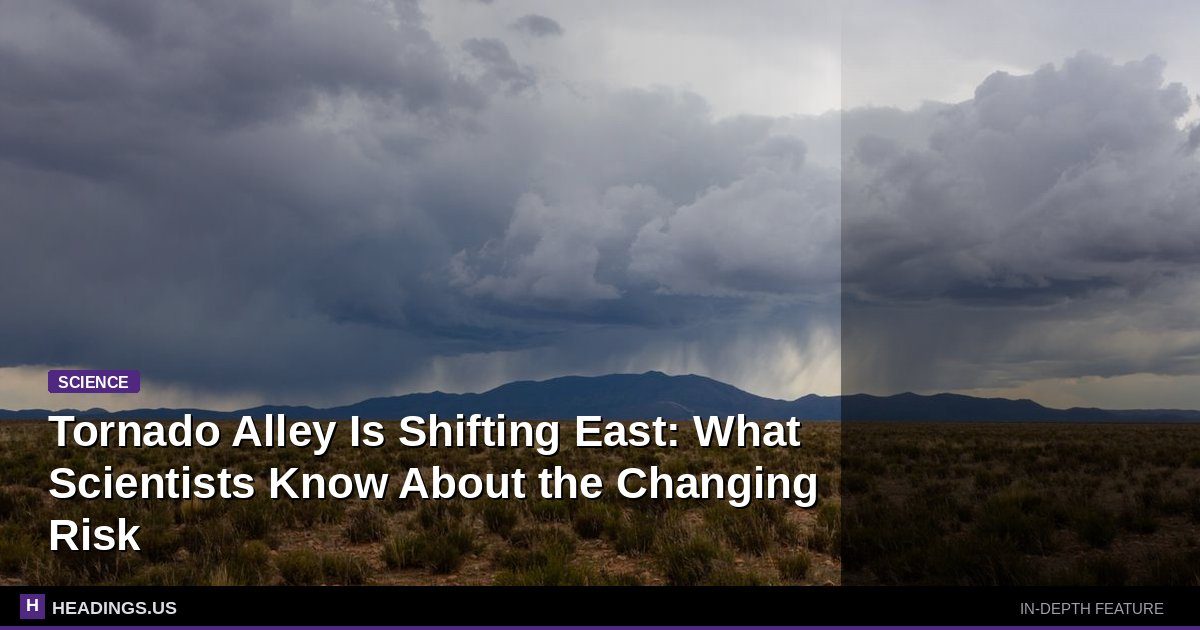
For generations, "Tornado Alley" meant one thing: the wide-open country running from Texas up through Oklahoma, Kansas, and Nebraska. That's where the twisters were supposed to be, and that's where storm chasers went to find them.
The data no longer tells that story so cleanly. Over the past four decades, the heart of U.S. tornado activity has been sliding east and south, out of the Plains and into the Mississippi Valley, the Southeast, and parts of the Midwest. The shift is gradual, measurable, and — for millions of Americans who never thought they lived in tornado country — consequential.
Here's what scientists actually know, what they're still arguing about, and what it means for where you live.
What the Data Shows
Tornado counts alone don't reveal much, because detection has improved dramatically. Doppler radar, spotter networks, and cellphone reports mean we simply see more weak tornadoes today than we did in 1970. So researchers focus on where strong tornadoes happen, not just how many.
A widely cited 2018 study in the journal npj Climate and Atmospheric Science by researchers at Northern Illinois University found that tornado activity — measured by the number of days with many tornadoes and by where strong EF2-and-above twisters cluster — has been shifting eastward. The traditional Plains hotspot has seen a decline. The Southeast and lower Midwest have seen an increase.
Federal data backs the pattern. According to NOAA's Storm Prediction Center, the states that now log the most tornadoes per square mile are not the classic Plains states. They include Mississippi, Alabama, Tennessee, and Arkansas — a region some researchers call "Dixie Alley."
Consider the raw numbers. Since 1950, Alabama has recorded more than 1,900 tornadoes, Texas more than 9,000. But Texas is enormous. Adjust for land area, and the Southeast's density of tornadoes climbs sharply. A 2023 analysis from the insurance and climate research firm Climate Central found that the frequency of tornado days was increasing across the Midwest and Southeast while decreasing across parts of Texas, Oklahoma, and Colorado.
The shift isn't a straight line. Some years the Plains roar back. But the long-term trend line points east.
Why the Shift Is Happening
Scientists don't have a single clean answer, and honest researchers say so.
One leading explanation involves the dry line — the boundary between dry air from the Southwest and moist air from the Gulf of Mexico. That boundary helps trigger supercells on the Plains. As the climate warms, the dry line and the moisture it interacts with appear to be moving east, pushing the most favorable tornado-forming conditions along with them.
Warmer Gulf of Mexico waters are part of the picture. More moisture in the air means more fuel for the thunderstorms that spawn tornadoes. A 2024 study in the Journal of Geophysical Research: Atmospheres pointed to expanding "tornado alley" conditions reaching deeper into the Southeast and Midwest.
There's also a seasonal angle. Tornado season in the Southeast runs earlier and later than on the Plains, and it increasingly overlaps with the cooler months when people aren't thinking about severe weather. Winter tornado outbreaks in places like Kentucky, Tennessee, and Alabama have become a recurring headline.
What scientists are careful to say: no single tornado or single outbreak can be blamed on climate change. Tornadoes are small, short-lived, and hard to model. The signal is in the pattern over decades, not in any one storm.
Why the East Is More Dangerous
This is the part that matters most, and it's not about wind speed.
A tornado of the same strength is more likely to kill people in the Southeast than on the Plains. Researchers have documented this repeatedly, and the reasons are structural.
- Population density. The Southeast packs more people into tornado-prone areas. A mile-wide tornado on the Kansas prairie may hit nothing. The same tornado near Birmingham or Nashville hits subdivisions.
- Trees and terrain. The Plains offer long sight lines. The Southeast is forested and hilly. Drivers and residents often can't see a tornado coming until it's on top of them.
- Housing stock. The region has a high share of mobile and manufactured homes, which offer almost no protection from a tornado. A 2021 study in Weather, Climate, and Society found that manufactured homes were a major factor in the Southeast's higher tornado death tolls.
- Nighttime storms. Southeast tornadoes frequently strike after dark, when people are asleep and warnings are harder to hear. NOAA research has found that nocturnal tornadoes are more than twice as likely to be deadly as daytime ones.
- Storm timing. Many Southeast tornadoes arrive with fast-moving lines rather than isolated supercells, leaving less lead time for warnings.
The result: the region with the fastest-growing tornado risk is also the region least built to survive it.
The Insurance and Cost Picture
The money tells its own story. Insured losses from severe convective storms — the category that includes tornadoes, hail, and straight-line winds — have climbed sharply. According to the insurance broker Aon, severe convective storm losses in the U.S. topped $50 billion in multiple recent years, a scale that used to be reserved for hurricanes.
That cost is landing in new places. Communities in Tennessee, Kentucky, Illinois, and Ohio that once saw a major tornado every few decades are now dealing with repeat events and rebuilding costs that strain local budgets.
Insurers have taken notice. Some carriers have tightened underwriting in hail- and tornado-prone states, raised deductibles for wind damage, or pulled back from certain markets altogether. Homeowners in the Midwest and Southeast are seeing premium increases that reflect a risk their grandparents never priced in.
What Scientists Still Don't Know
It's worth being clear about the limits of the science.
Researchers can show that activity is shifting. They cannot yet confidently attribute the shift to human-caused climate change, because tornadoes are too small and too short-lived for the climate models used to project future warming. The models that simulate global temperature don't resolve individual thunderstorms.
There's also disagreement about how much of the eastward trend is real versus an artifact of better detection. More radar, more storm spotters, and more cellphone cameras mean more tornadoes get recorded everywhere — but especially in areas that were once under-observed.
And there's the question of variability. The Plains had a quiet stretch in the 2010s, then a busy 2024 season. A decade of data can mislead. The strongest claims come from looking at 40 years or more.
"The trend is real, but the year-to-year noise is enormous," said one severe-storms researcher, summarizing the field's cautious consensus. "We're confident about the direction. We're much less confident about the pace."
What This Means for You
If you live in the Southeast, the lower Midwest, or the Ohio Valley, the old assumption that tornadoes are a Plains problem no longer holds. That changes what you should do.
- Know your risk regardless of your state's reputation. If you're in Mississippi, Tennessee, Kentucky, Alabama, Arkansas, Missouri, Illinois, Indiana, or Ohio, you live in an increasingly active corridor.
- Get a NOAA weather radio with battery backup. It works when cell networks fail and when you're asleep. It costs about $30 and is the single most-recommended item by emergency managers.
- Turn on wireless emergency alerts. Check your phone settings. Most modern phones have tornado alerts enabled by default, but people turn them off and forget.
- Identify your shelter before you need it. A basement or an interior room on the lowest floor, away from windows. In a mobile home, plan to leave and go to a designated shelter or a nearby sturdy building.
- Don't rely on a siren. Outdoor sirens are designed for people who are outside. They're not meant to wake you up indoors, and many communities don't sound them for every warning.
- Watch the timing. In the Southeast, the dangerous hours often run overnight and in the cooler months. Set a phone alert to bypass Do Not Disturb.
- Check your insurance. Confirm your policy covers wind and hail, and understand your deductible. In many states, wind and hail damage carries a separate, higher deductible than fire or theft.