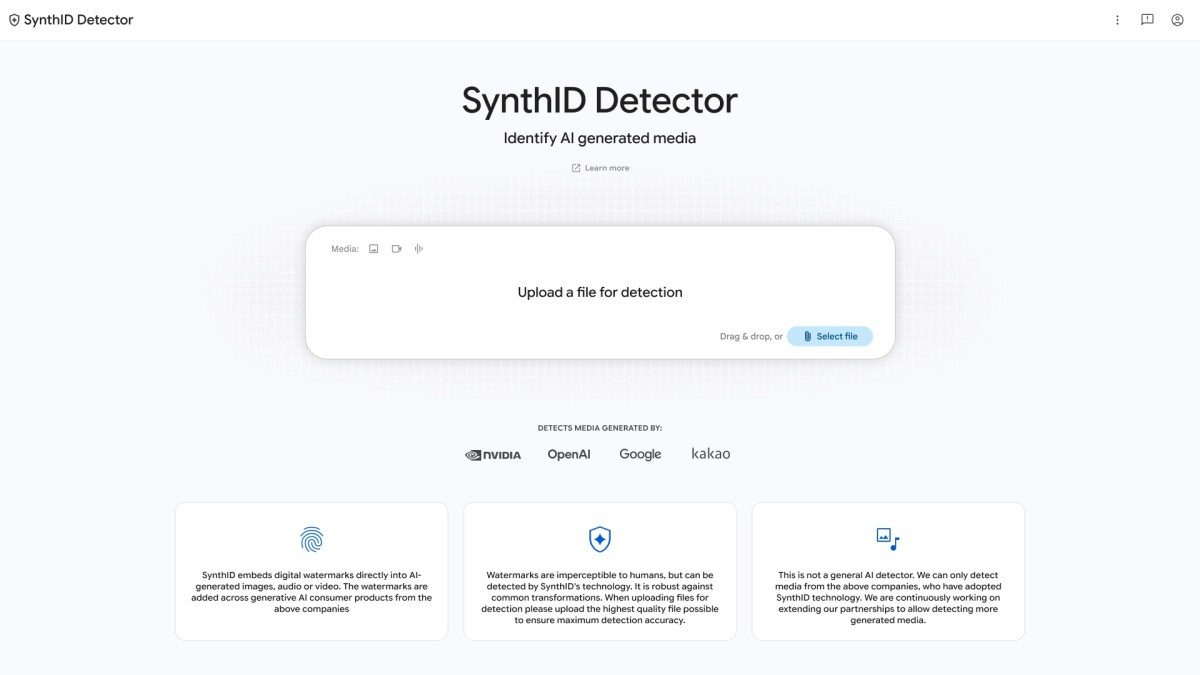
Google has launched a public website that can detect whether images, video, and audio were generated by artificial intelligence, expanding access to a watermarking system the company previously kept behind its own products. The SynthID Detector, announced via TechCrunch, lets anyone upload media files and check for the invisible digital signatures Google embeds when its AI tools create content.
The tool scans uploads for SynthID watermarks — imperceptible markers woven into pixels, audio waveforms, or video frames at the moment of generation. If the signature is present, the site reports which Google AI model produced the file. If it is absent, the site cannot confirm the content is human-made; it only confirms no SynthID mark was found.
That limitation matters because SynthID only works on content made by Google's own generative models, including Imagen and Veo. Media created with rival systems from OpenAI, Midjourney, or Meta carries no SynthID watermark and will pass through the detector unmarked. Google has said it is working with other companies on a common watermarking standard, but no cross-industry system is in place yet.
The launch arrives as AI-generated misinformation spreads through elections and social platforms. Watermarking has emerged as one of the few technical defenses that survives copying and re-uploading, unlike metadata tags that platforms and users can strip. Google first deployed SynthID in 2023 on AI-generated images in its Gemini chatbot, then extended it to video and audio.
Detection tools remain imperfect. Watermarks can degrade when media is cropped, compressed, or re-recorded, and researchers have shown some can be scrubbed with enough processing. Google has not published independent accuracy rates for the detector, and the site does not disclose how it handles files that have been altered after generation.
The company is pushing the tool as part of a broader transparency effort that includes labeling AI content in Search and YouTube. Google also joined the Coalition for Content Provenance and Authenticity, the group behind the C2PA standard, which attaches cryptographic provenance data to media at creation.
For now, the SynthID Detector gives journalists, fact-checkers, and ordinary users a free way to test one narrow question: did this file come from a Google AI model? The answer is definitive only when the watermark is found.